ELECTION: Why 2027 is ‘turn of Northern Nigeria’ – Danladi

Ordinarily, the North should take over in 2027 and make up the eight years before it returns to the South to maintain a fair balance and avoid tension moving forward. This is not a concession; it is a correction. It is not agitation; it is alignment with an unwritten but deeply respected protocol that has guided stability since 1999.
A renewed debate over Nigeria’s informal power-sharing arrangement has emerged ahead of the 2027 general elections, following a strongly worded political statement by ST Aliyu Yusuf Danladi, who argued that the North should reclaim the presidency after President Bola Ahmed Tinubu’s first term in office.
In the statement, Danladi questioned the constitutional basis for the recurring political slogan, “It is the turn of the North” or “It is the turn of the South,” while simultaneously defending what he described as a long-standing political understanding designed to preserve national balance and stability.
“Over the years, I have been searching the Nigerian Constitution for the phrase, “It’s the turn of the North, It’s the turn of the South”. If we must follow that trajectory, here are the facts:
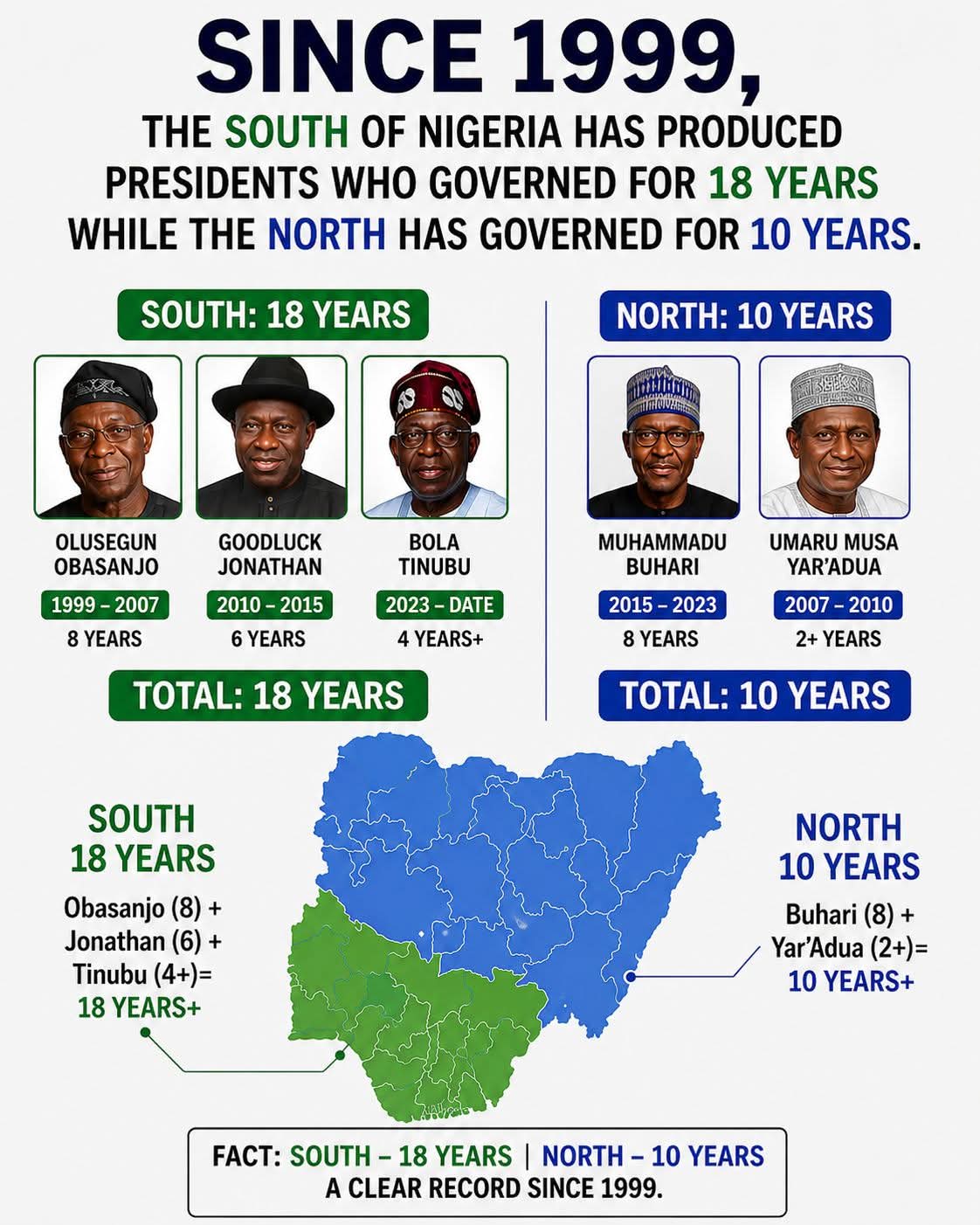
“At the expiration of Bola Ahmed Tinubu’s present tenure, the Southwest would have been in power for 12 years. The South for approximately 18 years. And if the South pushes for another 4 years, it would be 22 years. 22 years to 10 years is not only unfair but unjust. This is not a matter of sentiment; it is a matter of balance, equity, and the moral foundation upon which our fragile democracy stands.”
According to him, Nigeria’s democratic experience since 1999 has been sustained not merely through constitutional provisions but through an unwritten rotational arrangement between the Northern and Southern regions of the country.
Argument for Northern Completion of “Interrupted” Tenure
Danladi argued that by the end of President Tinubu’s current tenure, the Southwest would have occupied the presidency for a cumulative 12 years, while the South as a whole would have governed for about 18 years since the return to democracy in 1999. He added that if another Southern presidency emerges in 2027 and serves an additional four years, the South would have controlled power for 22 years compared to the North’s 10 years within the same democratic dispensation.
He described the imbalance as “unfair and unjust,” insisting that the issue goes beyond regional sentiment and touches on equity, trust, and democratic stability.
“Ordinarily, the North should take over in 2027 and make up the eight years before it returns to the South to maintain a fair balance and avoid tension moving forward. This is not a concession; it is a correction. It is not agitation; it is alignment with an unwritten but deeply respected protocol that has guided stability since 1999,” he said.
Yar’Adua’s death and the zoning disruption
Central to Danladi’s argument is the death of former President Umaru Musa Yar’Adua, who passed away in office in 2010 after barely completing two years of his first term.
He said Yar’Adua’s death disrupted the North-South zoning arrangement that had guided the Fourth Republic since 1999. Following Yar’Adua’s passing, then Vice President Goodluck Jonathan from the South completed the tenure and subsequently contested and won another term in 2011.
According to Danladi, the North effectively lost six years of presidential tenure under that arrangement but chose national unity over political confrontation.
“If the North had insisted that Jonathan step down after completing Yar’Adua’s tenure, it would have been interpreted as hostility,” he said. “The North chose peace over provocation.”
Historical context of power rotation
The statement also revisited the political circumstances surrounding Nigeria’s transition to democracy in 1999. Danladi recalled that the presidency was deliberately zoned to the Southwest following the annulment of the June 12, 1993 election believed to have been won by Moshood Kashimawo Olawale Abiola.
He described the emergence of former President Olusegun Obasanjo as part of a broader national healing process intended to calm tensions and restore confidence in the federation.
Danladi further praised Obasanjo for ensuring that power returned to the North after completing his two terms in office in 2007, arguing that the former president prioritised political balance over personal or regional interests.
He referenced the presidential ambitions of former Rivers State Governor Peter Odili, who many considered a strong contender at the time, but whose aspirations did not materialise as power shifted northward with the emergence of Yar’Adua.
According to Danladi, that decision reflected what he termed “Obasanjo’s protocol” — an informal but stabilising understanding that presidential power should rotate between North and South to maintain national cohesion.
Atiku, inclusion and national stability
Danladi also addressed ongoing conversations around former Vice President Atiku Abubakar’s presidential ambitions, stating that the presidency is “not in anyone’s gift basket” but rather a national institution shaped by history, fairness, and collective consensus.
He argued that Atiku’s previous presidential bids demonstrated inclusion, particularly through alliances with politicians from the Southeast.
The statement further noted that leaders associated with the late General Shehu Musa Yar’Adua and former President Obasanjo historically emphasised fairness, continuity, and national stability over sectional dominance.
Warning against regional imbalance
Danladi warned that prolonged perceptions of regional dominance could deepen distrust and resentment within the federation if not carefully managed.
He maintained that allowing the North to complete what he described as its interrupted eight years would reinforce political fairness and demonstrate that unwritten national agreements still carry moral and political value.
“This is not about North versus South,” he said. “It is about democratic stability and national peace.”
Call for broader equity, including Southeast representation
Beyond advocating for Northern completion of the presidency, Danladi also argued that the Southeast deserves a full eight-year presidential opportunity rather than a single four-year term whenever the region eventually produces a president.
He urged political leaders to rise above short-term political calculations and focus instead on national unity and future generations.
“The North making up its eight years should not be seen as a demand for power,” he concluded. “It should be understood as a proposition rooted in peace, fairness, and democratic balance.”