RESTORING NIGERIA’S PROSPERITY: The Atiku–Amaechi rescue covenant, By Chief Akin Ricketts
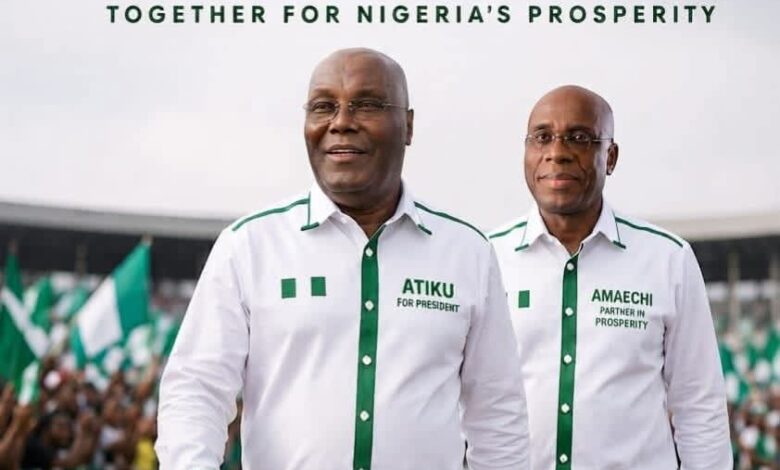
We no longer need a government that tries to hold all the power; we need one that is confident enough to share it. In the upcoming election, the most qualified leaders will be those who recognise that their success should be measured by the businesses they enable and the burdens they lift from the shoulders of the Nigerian people.
Nigeria today stands at a critical crossroads where the old, state-centric model of development has clearly run its course and, from all indications, failed. For too long, our national conversation has been trapped in the illusion that the government must be the primary engine of prosperity. The sad reality is that our progress has been stifled by a system that tries to do everything and, consequently, does very little well. True economic liberation requires moving from a government that controls to one that enables. This is the foundation of the Atiku–Amaechi Rescue Covenant.
At the heart of this necessary pivot are the shared philosophies of Atiku Abubakar and Rotimi Amaechi. Despite their different political paths in times past, both men have championed and arrived at the same hard-won conclusion regarding how we govern: the state’s duty is to set the rules, not to run the game. Atiku captured this shift in direction during the 24th Lagos Business School Convocation, where he stated, “I believe in small government and that the private sector should be given the opportunity to play more roles in the economy.” This is a solemn admission that the government’s reach has exceeded its grasp for decades, and that it is time for a new approach.
Amaechi, looking at the problem through the lens of infrastructure and operations, echoed this sentiment with even greater directness. When speaking at a business forum, he observed, “The only area yet to be privatised is the railway… when the concession is completed, government will play only regulatory functions.” Together, these perspectives form a binding blueprint for 2027 and for how government in the 21st century should be run. They represent a rare alignment between two heavyweights who have pledged that the state functions best when it acts as a referee, ensuring a level playing field, rather than as a failing player.
We have seen, in real time, exactly what happens when the government steps back and honours this kind of covenant. Think back to the telecommunications sector in the early 2000s; before liberalisation, phone lines were a luxury reserved for the elite, and the state-run NITEL was a stagnant monument to inefficiency. Once the sector was opened to private competition, the cost of entry plummeted, and millions of Nigerians—from the street hawker in Onitsha to the farmer in Zamfara—gained access to the digital world. The same potential exists in the power sector today. Manufacturers in the Aba industrial cluster currently spend over 40% of their operational budgets on diesel for generators, a “hidden tax” that makes their goods uncompetitive against imports. A government that prioritises private-led energy delivery, as both Atiku and Amaechi have proposed, would turn those wasted diesel costs into new production lines and thousands of entry-level jobs.
These two men represent a bridge between the traditional establishment and the urgent, modern demand for a performance-based economy. Choosing such a path in 2027 means moving away from the heavy-handed bureaucracy that has kept our industries in the dark and toward a partnership that prioritises results. This is about selecting leaders who have entered into a covenant with the people to hand the steering wheel of the economy over to those who know how to navigate it—the Nigerian entrepreneurs.
The benefits for the average citizen would be both immediate and life-changing. When the private sector is unshackled under this rescue plan, job creation moves from being a government promise to becoming a market necessity. Currently, businesses are forced to hoard cash to survive the lack of public infrastructure. If the State focuses on providing an enabling environment instead, that capital flows directly into expansion. Furthermore, the cost of living would stabilise. The logistics bottlenecks at the Apapa ports, which keep the price of imported raw materials and food artificially high, are a direct result of bureaucratic control. By allowing professional, private management of these trade arteries, we lower the baseline cost of production, which in turn lowers the price of a bag of rice or a carton of milk at the local market.
We no longer need a government that tries to hold all the power; we need one that is confident enough to share it. In the upcoming election, the most qualified leaders will be those who recognise that their success should be measured by the businesses they enable and the burdens they lift from the shoulders of the Nigerian people. By embracing this covenant, we are finally choosing a future where our economy is allowed to breathe, grow, and reward the immense ingenuity of its citizens.
Anticipate!!!
*Chief Akin Ricketts is a chieftain of the African Democratic Congress (ADC).