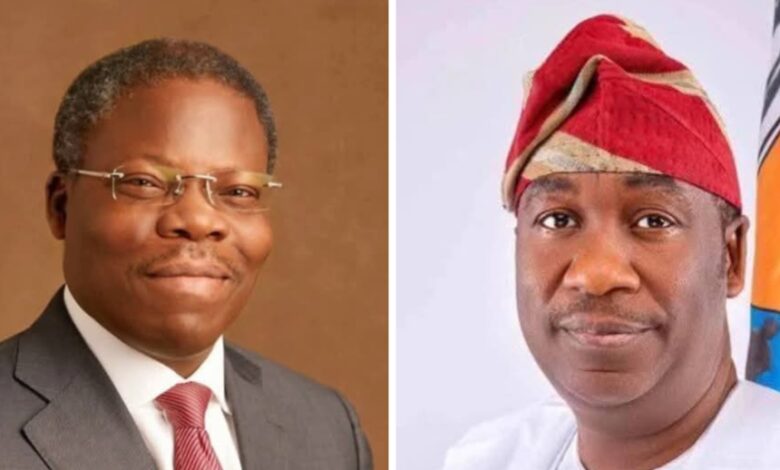
Is the Hamzat/Gbeleyi Combination the New Political Game for Lagos 2027?
By ABANIKANDA OLUMORO (UK)

While the indigenous leadership advocates are not disputing his credentials for now, available records show that he is not qualified because he is not an indigene of Lagos, which is not in line with their position and demands rooting for indigenous Governor, Deputy Governor and others from 2027.
Nigerians at home have continued to endure one of the most difficult periods of economic, social and high level of insecurity challenges in the recent history of our country. These challenges raise deeper questions about governance, leadership priorities, and proper policy direction.
As another electoral cycle gradually approaches, many Nigerians are once again reflecting on the importance of leadership recruitment, accountability, and the need for citizens to make informed political choices. These conversations have become particularly intense in Lagos State, Nigeria’s commercial nerve center and arguably its most politically strategic state.
Recent political developments and speculations surrounding the 2027 governorship race have generated heated debate among political observers, stakeholders, and advocates of indigenous political representation in Lagos State.
Whether factual or speculative, the Hamzat/Gbeleyi will sparked considerable reactions because it touched on a highly sensitive issue in Lagos politics — the growing agitation by indigenous Lagosians for greater control over the political leadership of their ancestral state.
The Indigenous Question in Lagos Politics
We find it very despicable that a man would be governor, deputy governor, member of the National Assembly or state Assembly in our Lagos State because he claims to be an indigene based on unverifiable documents presented and some distorted history told by some elders, only for his siblings to be claiming indigeneship, or are found only to be politically active in his/her actual state different from Lagos (Obafemi Kadiri Hamzat and Ayo Gbeleyi for example). The political conversations in Lagos State appear to have shifted in recent weeks. Reports and speculations now suggest that the alleged Hamzat/ Seyi Tinubu arrangement may have encountered resistance within the Governor’s Advisory Council (GAC).
For years, the “Lagos-for-Lagos” movements and similar advocacy groups have argued that indigenous Lagosians have been systematically sidelined in the governance structure of the state. Their demands are straightforward: that the positions of Governor, Deputy Governor, Speaker of the House of Assembly, Secretary to the State Government, and other top offices should primarily reflect the indigenous communities of Lagos State.
To many of these groups, the controversy surrounding the alleged Hamzat/Gbeleyi arrangement represented yet another attempt to deny indigenous Lagosians meaningful political leadership. They find it despicable that a man would be governor or senator or member of the House of Representatives or Speaker of the State House of Assembly in their Lagos because he claims to be an indigene based on documents presented, now being subject of controversy, only for his siblings to claim indigeneship or are found to be active as indigenes of State other than Lagos State.
Emergence of a New Political Calculation
The possible emergence of Ayo Gbeleyi’s name in Lagos political calculations has generated fresh conversations, especially among advocates of indigenous political representation.
Supporters of the proposed arrangement describe Gbeleyi as a technocrat with extensive experience in public finance, economic management, and public-private partnerships. His profile is being projected as one that combines administrative competence with indigenous identity credentials.
According to political insiders, Gbeleyi’s emergence may represent an attempt to balance Lagos political equations by pairing Hamzat with an individual believed to possess Awori roots from Lagos West Senatorial District — the region often described as electorally dominant in Lagos politics.
Who Is Ayo Gbeleyi?
Ayo Gbeleyi is said to have been born and raised in Oshodi-Isolo Local Government Area and is widely presented by supporters as an Awori indigene of Lagos West.
His public service record includes serving as Commissioner for Finance in Lagos State,
At the federal level, he also chaired the board of the Federal Mortgage Bank of Nigeria (FMBN).
Currently, Gbeleyi serves as Director-General of the Bureau of Public Enterprises (BPE), one of Nigeria’s most influential economic reform agencies responsible for privatization policies and public enterprise restructuring.
While the indigenous leadership advocates are not disputing his credentials for now, available records show that he is not qualified because he is not an indigene of Lagos, which is not in line with their position and demands rooting for indigenous Governor, Deputy Governor and others from 2027.
Questions Over Indigeneity
Despite these credentials, critics and Lagos indigenous advocacy groups continue to raise questions regarding the authenticity of some political claims surrounding Gbeleyi’s Lagos roots.
Some individuals scrutinizing his background have pointed to reported family connections with Ogun State politics. Questions have also emerged regarding alleged ties to Ado/Odo Ota in Ogun State and claims concerning his family lineage.
Particular attention has been drawn to reports about a certain Oluseyi Bolanle Gbeleyi, who reportedly served in the Ogun State House of Assembly between 1999 and 2003, as well as claims that Ayo Gbeleyi’s father, Hon. Chief E.A. Gbeleyi (Otun- Oba of Igbesaland) Former Federal Minister of Labour, 1966 under Abubakar Tafawa Balewa’s Government.
For indigenous advocacy groups, these issues go beyond personal biography. They represent broader concerns about identity, political ownership, and constitutional rights regarding who should govern Lagos State.
Lagos 2027: A Political Crossroads
As political maneuvering intensifies ahead of 2027, one reality appears increasingly clear: the issue of indigenous representation in Lagos politics is unlikely to disappear quietly.
For many indigenous groups, the struggle is no longer merely about party politics but about recognition, inclusion, and what they consider historical political justice.
At the same time, political strategists within the APC face the delicate challenge of balancing electoral calculations, elite interests, regional power structures, and public perception.
Whether the eventual ticket becomes Hamzat/Gbeleyi, or an entirely different combination, the debates already unfolding reveal the growing tension between political succession planning and grassroots demands for indigenous political inclusion.
What remains uncertain is whether Lagos political power brokers will genuinely accommodate those demands or continue to rely on elite consensus and strategic political engineering.
For now, Lagos stands at a critical political crossroads, and the decisions made in the coming months may shape not only the future of the state but also broader conversations about identity, representation, and democracy in Nigeria.
*Olumoro, a regular Diasporan contributor to local political development in Nigeria, writes from UK.
DISCLAIMER: All opinions expressed in this article are strictly of the author and not of The DEFENDER Newspaper)