Concerned Fulani Citizens launches with a bold statement: “Return to History of Amalgamated Nigeria, Only Way Out of Ethno-Religious Conflicts”
By IBRAHIM BARKINDO CHUBADO
It appealed to Nigerians to reject ethnic stereotyping, restore historical education and recognise the country as a shared national home whose stability depends on justice, mutual respect and peaceful coexistence among its diverse peoples.
The Concerned Fulani Citizens has called on Nigerian authorities at federal and state levels to recognise Fulani citizens as equal stakeholders in Nigeria, entitled to the same rights and privileges as Nigerians of Yoruba, Igbo, Efik, Ibibio and other ethnic groups.
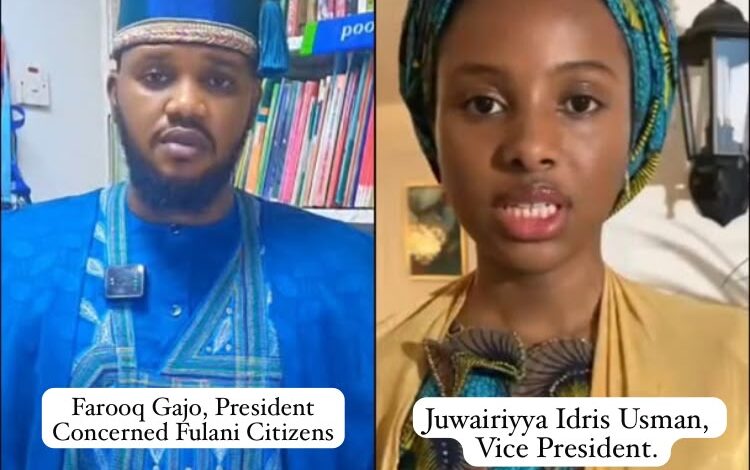
The call followed a joint meeting of the group’s Board of Trustees and Management virtually launching the group on October 1, 2026. At the launch a statement jointly signed by its President, Farooq Gajo; Vice President, Juwairiyya Idris; and Secretary-General, Barrister Sani Bunza, expressing the group concerns about the deepening ethno-religious hate especially the stigmatisation of Fulani people in the country, posited that Nigeria was created as a country for people of diverse ethnic, religious and cultural backgrounds who had become deeply interconnected through marriage, commerce, religion and other social relationships.
The group said Nigerians must embrace peaceful coexistence and reject efforts to portray any ethnic group as an enemy of the country.
“We are Fulani. Our language is Fulfulde, but we fall under a region of Nigeria where the Hausa language is nationally and constitutionally recognised, and we are thus Hausa speakers, just as we see ourselves as an intertwined people in the multi-ethnic, multi-religious and multi-cultural country that God has blessed us with,” it said.
The group urged Nigerians to extend to one another the “olive branch” of peace, reconciliation and goodwill, stressing that a country continually cursed by its own citizens could hardly prosper.
It also rejected what it described as the stigmatisation of Fulani people as criminals.
“We are proudly Fulani people, and we are proud of our socio-economic and cultural background, which is rooted in cattle rearing and pastoralism,” the group said.
According to the Concerned Fulani Citizens, pastoralism is a legitimate agricultural activity that deserves government support just as crop farming does.
“We are not a liability, and we should be seen and treated as co-contributors to national economic development,” it said, arguing that Fulani citizens should be free to live, work and conduct lawful businesses anywhere in Nigeria in accordance with the Constitution.
The organisation also challenged the argument that Fulani people could not be regarded as Nigerians because Fulani communities exist across several African countries.
It pointed to the existence of Yoruba communities outside Nigeria, including the Republic of Benin and other West African countries, arguing that the international spread of an ethnic group does not deprive its members of Nigerian nationality.
The group cited historical accounts concerning Yoruba links with Brazil, Barbados and other parts of the Caribbean. It also referred to comments attributed to the Olu of Ilaro and Paramount Ruler of Yewaland, Oba Kehinde Olugbenle, about historical links between Ilaro people and communities in Brazil and Barbados.
It further cited a reported interview with the late Akran of Badagry, De Wheno Aholu Menu-Toyi I, published in Sunday Vanguard, in which the monarch discussed the movement of people through Badagry during the trans-Atlantic slave trade.
The group said these examples demonstrate that ethnic communities have historically crossed political boundaries, migrated and established settlements in different parts of West Africa and beyond.
According to the group, “the peoples who now make up Nigeria — be they Hausa, Efik, Ibibio, Yoruba, Igbo and so on — did not originate from a single political or territorial entity. They migrated, settled, conquered, merged and established communities across the region long before the creation of Nigeria.”
It therefore called for the restoration of Nigerian history as a major component within the history of West Africa as a central part of education, arguing that historical knowledge could help Nigerians understand how the modern Nigerian state emerged and reduce ethnic misconceptions.
The group recalled that Nigeria was created as a single political entity on January 1, 1914, following the amalgamation of the Northern and Southern Protectorates and the Colony of Lagos under British colonial rule, with Lord Frederick Lugard as Governor-General.
It noted that as Nigeria subsequently moved towards self-government the British authorities appointed Sir James Wilson Robertson as Governor-General in 1955, with Sir Abubakar Tafawa Balewa becoming Chief Minister in 1957 a position with the designation of the Prime Minister.
“Under Robertson, on August 30, 1957, Sir Abubakar Tafawa Balewa was appointed Chief Minister, a position that carried the designation of Prime Minister, of the self-governing Nigeria, becoming the first indigenous Nigerian to serve as head of government.
“On October 1, 1960, Nigeria became an independent sovereign country, although it remained a constitutional monarchy within the Commonwealth, with Sir James Robertson continuing as Governor-General of Nigeria and representative of the British Crown in the country.
“James Robertson continued until November 16, 1960, when Dr. Nnamdi Azikiwe became the first indigenous Governor-General, succeeding Robertson.
“Sir Abubakar Tafawa Balewa, who had been Chief Minister and designated Prime Minister since August 30, 1957, continued to serve as head of government under Governor-General Nnamdi Azikiwe from November 16, 1960, until Nigeria became a republic and Azikiwe became the first President of the Federal Republic of Nigeria on October 1, 1963 and Tafawa Balewa became substantive Prime Minister (the Head of Government).
“It will be recalled that what is known as Nigeria’s First Republic lasted from October 1, 1963, until the first military coup, which took place on January 15, 1966.
The group argued that the history of Nigeria before and after independence should be taught comprehensively rather than through narratives that attribute the country’s challenges to one ethnic group.
It particularly recalled that during the First Republic, the three regions exercised substantial political and economic powers under their respective premiers: Sir Ahmadu Bello in the Northern Region, Chief Obafemi Awolowo in the Western Region and Dr Michael Okpara in the Eastern Region.
According to the group, the regions developed their economies from their respective capitals (Kaduna, Ibadan and Enugu) and agricultural resources, including cotton, hides and skins and groundnuts in the North; cocoa and timber in the West; and rubber and timber in the East.
It argued that the General J.T.U. Aguiyi-Ironsi led military takeover of Nigeria in 1966 and the subsequent centralisation of political authority, which changed the nation’s governing arrangement from the Federal system to the Unitary system, fundamentally altered the country’s federal structure.
“Those Premiers had the power in their respective Regions,” the group said, asking why the Fulani should subsequently be blamed for Nigeria’s political and economic challenges.
It added: “How, then, was it the problem of the North or the Fulani race that the power — which President Nnamdi Azikiwe and Head of Government/Prime Minister Abubakar Tafawa Balewa exercised — ran successfully with all three Premiers of the three Regions without problems until General Aguiyi-Ironsi overthrew the government and took power to the centre?”
The Concerned Fulani Citizens said the way forward was not ethnic blame but a return to a fuller understanding of Nigeria’s history and the circumstances that shaped its present political structure.
“The only way out of these problems of national conflict is for those in charge of this country — what we can call the Establishment — to ensure the restoration of History, so that all Nigerians, from primary school to university, can have unhindered access to the history of Nigeria and not be left with hate-based history obtained from their localities,” it said.
The group maintained that Fulani people should not be collectively blamed for crimes committed by individuals, just as other ethnic groups should not be collectively held responsible for the actions of individual members.
It also argued that conflicts between farmers and herders were not new and had historically been addressed through local agreements and community mechanisms.
“Being herdsmen could not have been the problem because both Fulani herdsmen and their host communities everywhere have always had ways of resolving the economic issues resulting from farmer-herder relations for centuries,” the group said.
It appealed to Nigerians to reject ethnic stereotyping, restore historical education and recognise the country as a shared national home whose stability depends on justice, mutual respect and peaceful coexistence among its diverse peoples.