{FOR THE RECORD} Still a vital question on the Wike’s ‘Rainbow Coalition’ and its European dimension
By ABANIKANDA OLUMORO (UK)
Now, the idea of a Rainbow Coalition – which means LGBT rights to European governments – is being interpreted by some critics as Wike’s latest design to win the Western powers into developing greater interests in Nigeria, with a view to supporting Tinubu’s re-election. They argue that the possible price could be greater foreign access to Nigeria’s natural resources and solid minerals. Such concerns inevitably bring Nigeria’s colonial history into the discussion.
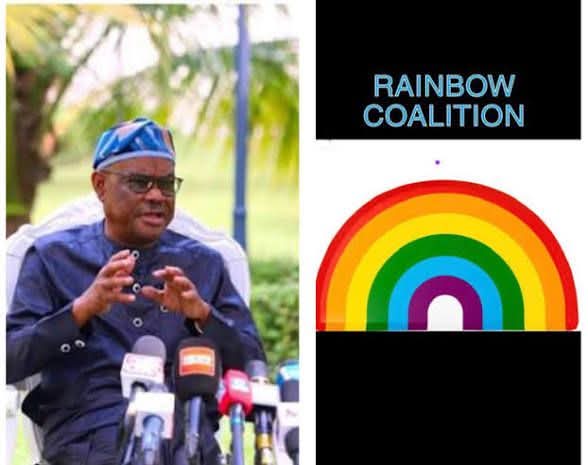
The political controversy surrounding the “Rainbow Coalition” being promoted by Federal Capital Territory Minister, Nyesom Wike, has taken another dimension, with questions being raised over whether the terminology and structure of the alliance could have implications beyond Nigeria’s 2027 presidential election.
While Wike has openly stated that his objective is to mobilise support across political parties for President Bola Ahmed Tinubu’s re-election, some Nigerians are asking whether the initiative is also designed to project an image of broad political inclusion that could appeal to European political circles.
He made no secret of the central purpose of the coalition as he repeatedly said that his immediate political priority is Tinubu’s re-election in 2027 and that the Rainbow Coalition is a platform through which politicians from different political parties can support the President without necessarily abandoning their respective parties. He also insisted that the coalition is not an APC structure and that political parties remain free to field candidates for governorship and legislative elections.
It is this cross-party character that has prompted questions about the choice of the word “Rainbow.” Internationally, the rainbow is widely associated with diversity and inclusion and, particularly in Europe and other Western societies, it associates with LGBT rights.
Knowing what LGBT rights mean to European governments and considering what critics describe as Wike’s desperation, despite the evident hardship under the Tinubu administration that he insists must be re-elected, those who see deeper political calculations in the development are asking on the FCT Minister’s intention to choose the word “Rainbow” for the coalition. This is because, according to them, Wike is fully aware of the attention and influence such symbolism could attract from the Western countries.
The question is: why should a government that has spent four years boasting that it has performed better than any preceding administration be so interested or engrossed in seeking the support of European governments for its re-election?
If you have truly performed, and knowing that governance is ultimately about satisfying the people, why would you need either the United States government, the European Union or individual European governments to help you secure your re-election? Critics may reasonably ask whether such international engagement is being driven by considerations beyond ordinary diplomatic relations, especially when it bothers on what Tinubu was doing in London and France if not for this reason.
The truth, according to critics of Wike, is that having openly declared that a victory by former Vice President Atiku Abubakar or former Anambra State Governor Peter Obi would pose danger to him personally and politically, he has become desperate to prevent either of the two opposition figures from winning. Wike has reportedly expressed the fear that either of them could “go after me” because of his past political actions.
From this perspective, critics argue that the Rainbow Coalition is about Wike’s political survival rather than Nigeria or even Tinubu himself.
Recall that statements such as “we rigged the 2023 elections and will rig it again” have recently been attributed to Wike. There have also been allegations of attempts by elements within the Tinubu administration to use the judiciary to frustrate opposition presidential candidates and make the All Progressives Congress (APC) presidential candidate the only name on the ballot for 2027. Such allegations, whether ultimately established or not, have contributed to the perception among critics that some political actors are becoming increasingly desperate.
Wike was also reportedly quoted as saying that although some plots had failed, efforts would still be made to ensure that Atiku and Obi did not contest the 2027 election against Tinubu. Not long afterwards, critics pointed to developments involving an alleged attempt by an APC lawmaker from Edo State to revive an already dead corruption-related allegations arising from an old investigation carried out without any indictment of the former vice president.
The coalition of politicians from various political parties who claim to remain members of their original parties while openly campaigning for Tinubu of another party, APC, has therefore attracted criticism from Nigerians who describe the arrangement as an “anti-Nigerian corps” that must be resisted at all costs.
Now, the idea of a Rainbow Coalition – which means LGBT rights to European governments – is being interpreted by some critics as Wike’s latest design to win the Western powers into developing greater interests in Nigeria, with a view to supporting Tinubu’s re-election. They argue that the possible price could be greater foreign access to Nigeria’s natural resources and solid minerals.
Such concerns inevitably bring Nigeria’s colonial history into the discussion. Nigeria attained independence from British colonial rule on October 1, 1960, although the country retained the constitutional status of a dominion within the Commonwealth, with Sir James Wilson Robertson serving as Governor-General until November 16, 1960, when Dr. Nnamdi Azikiwe became the first indigenous Governor-General.
Nigeria eventually became a republic on October 1, 1963, when Azikiwe became the country’s first President of the Federal Republic of Nigeria and Sir Abubakar Tafawa Balewa continued as Prime Minister and Head of Government.
People who have studied or witnessed Nigeria’s difficult journey from colonial rule to independence have therefore begun to describe Wike’s Rainbow Coalition, metaphorically, as the politics of a prodigal son who would go to any length to sell off his inheritance only to regret it later and return home seeking mercy.
We are not going to allow him. Nigeria is backward 66 years after Independence because of people like Wike.
Otherwise, what on earth could make any Nigerian, with the abundance of historical facts that we have, ever think of going to sell our country in its entirety back into the slavery of Europe? That is what Wike is doing. All that he is interested in is for Tinubu to win re-election, not because he thinks Tinubu has done well, not because he wants what is good for Nigeria, but because he wants to continue to be relevant. If achieving that would mean selling the country back into the control of the West, Wike does not mind.
Our Yoruba proverb says “A building owner must not allow erosion to achieve its plan of collapsing and washing away the building.” So, we won’t fold our arms and allow Wike to sell us off to Europe through a pretentious Rainbow Coalition in the name of playing the politics of 2027.
As the questions continue, the argument being advanced by Wike’s critics is that his courting of Western or European governments is aimed at ensuring that those governments do not monitor or issue adverse reports on alleged undemocratic activities and electoral violations that critics fear could occur during the 2027 elections.
That, they argue, is the only reason a politician in Nigeria would solicit the support of a foreign government to win an election in his own country.
Otherwise, how is it the business of France, the European Union or any European government to determine who should govern Nigeria?
Critics contend that such foreign influence would amount to a troubling return to the era when Nigeria’s political destiny was controlled by colonial powers, from the amalgamation of the Northern and Southern Protectorates on January 1, 1914, through independence on October 1, 1960, and ultimately the attainment of republican status on October 1, 1963.
They argue that Tinubu’s alleged desperation for re-election has given Wike the opportunity to develop the idea of a “Rainbow Coalition” as a vehicle for securing political support, just as critics have accused the administration and its allies of using the judiciary since 2023 in ways they believe have weakened Nigeria’s democratic process.
The symbolism of the word “Rainbow,” associated internationally with LGBT rights and diversity, particularly in Europe, has consequently become part of the wider debate because of the different meanings the word can carry in international political communication.
The controversy comes at a time when Europe has increasing strategic interest in Nigeria’s economic potential, including its solid-mineral resources. The European Union is seeking diversified sources of critical raw materials needed for industrial, technological and energy-related applications. Nigeria’s mineral deposits therefore give the country a potentially important place in the emerging global competition for strategic resources.
This makes questions about political stability, regulatory continuity and foreign investment particularly relevant.
It is against this broader background that some Nigerians are interpreting the Rainbow Coalition as more than an ordinary electoral alliance. Their concern is that a political structure capable of demonstrating support for Tinubu beyond the APC could be presented internationally as evidence of a broad national constituency behind the President.
Whether European governments would interpret it in that manner, or whether such an image would influence their diplomatic calculations, remains a matter of speculation unless supported by direct evidence.
The discussion has also been fuelled by a recent publication by The Economist titled, “Nigerians dislike their president, but may re-elect him anyway.” The publication discussed factors including incumbency, opposition fragmentation, voter turnout and the political advantages available to an incumbent.
On Friday, October 2, 2026, United States lobbying firm Von Batten-Montague-York interpreted the publication as evidence of a broader international narrative about the possibility of Tinubu’s re-election despite public dissatisfaction. That interpretation is Von Batten-Montague-York’s political analysis of The Economist publication, suggesting that it could form part of a coordinated effort to secure Tinubu’s victory.
The central question raised by critics, therefore, is not simply why Wike supports Tinubu, since Wike himself has answered that question publicly. Rather, they are asking whether the political messaging surrounding the Rainbow Coalition is being constructed partly with an international audience in mind.
That question becomes particularly sensitive when Nigeria’s strategic economic assets—including oil, gas and solid minerals—are considered alongside foreign investment and geopolitical competition.
For those asking these questions, the issue is therefore bigger than Wike, Tinubu or the 2027 presidential election. It is about whether Nigeria’s political choices should remain determined principally by Nigerians and whether any political coalition, regardless of the symbolism attached to its name, should be scrutinised when its activities intersect with foreign interests and the country’s strategic economic resources.
Olumoro, a Nigerian in the Diaspora, writes from the UK.