Could Iran-Saudi rivalry ultimately challenge the Saudi monarchy? — A geopolitical projection
By KEMI KASUMU with Agencies


One possible — though highly speculative — scenario would be the emergence of an alternative political arrangement in which the administration of Makkah and Madinah received a distinct constitutional or international status, somewhat analogous in principle, though not necessarily in structure, to the special sovereign status enjoyed by Vatican City within Italy, especially now that the Crown Prince – Muhammad bin Salman – in the country is busy defacing the country and turning it into more secular state than Islamic.
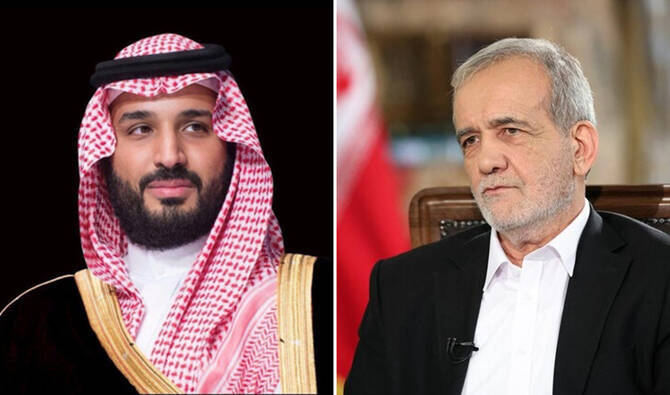
The escalating confrontation between Iran and Saudi Arabia raises a broader geopolitical question that goes beyond the immediate military and diplomatic tensions in the Middle East: Could the rivalry eventually evolve into a struggle over the political system governing Saudi Arabia?
At first glance, Saudi Arabia’s recent efforts to strengthen its strategic relationships with Turkey and Pakistan could be interpreted as an attempt to build a broader regional security front against Iran. The reported understanding that an attack on one member would be treated as an attack on all would represent a significant development if formally established and implemented.
The strategic significance is considerable. Turkey operates a presidential political system, while Pakistan is a parliamentary republic. Saudi Arabia, by contrast, remains an absolute monarchy under the House of Saud. Bringing countries with fundamentally different political structures into a common security arrangement could therefore have implications extending beyond conventional military cooperation.
Historically, Iran itself provides an important point of comparison. The country was ruled by a monarchy under the Pahlavi dynasty until the 1979 Islamic Revolution, which overthrew Shah Mohammad Reza Pahlavi and established the Islamic Republic.
That history raises a provocative question: Could the political transformation that occurred in Iran eventually be contemplated for Saudi Arabia, particularly if the confrontation between Riyadh and Tehran develops into a prolonged regional struggle?
At present, there is no credible public evidence that Iran has an established policy of overthrowing the Saudi monarchy or replacing the Kingdom with a republican system. Such a development would also represent an extraordinarily ambitious undertaking, given Saudi Arabia’s military capabilities, its strategic partnerships and the importance of the country to the global economy and Muslim world.
Nevertheless, geopolitical conflicts sometimes produce consequences that were not initially anticipated by the principal actors. If Iran were to emerge from the current confrontation substantially stronger, Saudi Arabia could face increased pressure over its regional policies, its alliance structure and its internal political arrangements.
The issue becomes even more sensitive because Saudi Arabia is home to Makkah and Madinah, Islam’s two holiest cities. Their religious significance transcends the political boundaries of the Saudi state, making any discussion about the future political structure of the Kingdom particularly consequential for the wider Muslim world.
One possible — though highly speculative — scenario would be the emergence of an alternative political arrangement in which the administration of Makkah and Madinah received a distinct constitutional or international status, somewhat analogous in principle, though not necessarily in structure, to the special sovereign status enjoyed by Vatican City within Italy, especially now that the Crown Prince – Muhammad bin Salman – in the country is busy defacing the country and turning it into more secular state than Islamic.
Such an arrangement would be unprecedented in the Islamic world and would raise enormous questions about sovereignty, the custodianship of the holy sites, the role of the Muslim world in their administration and the future political identity of Saudi Arabia.
Another theoretical possibility would be the transformation of the Saudi political system from an absolute monarchy into a constitutional monarchy or republic. However, describing a future Saudi Arabia as the “People’s Republic of Saudi Arabia” should, at this stage, be regarded strictly as a political hypothesis rather than a forecast based on confirmed evidence.
The more immediate reality is that the Middle East appears to be entering a period in which traditional alliances and assumptions are being reassessed. Saudi Arabia is seeking stronger security guarantees and regional partnerships, while Iran is attempting to preserve and expand its strategic influence.
Turkey and Pakistan, meanwhile, occupy increasingly important positions in the emerging regional balance of power. Their involvement could significantly affect the strategic calculations of both Riyadh and Tehran.
The fundamental question, therefore, may not simply be who wins the next confrontation between Iran and Saudi Arabia. It may be whether the conflict eventually reshapes the political architecture of the Middle East itself.
For Saudi Arabia, the challenge is to determine whether its monarchy can adapt sufficiently to a rapidly changing regional environment while maintaining its internal stability, strategic partnerships and historic responsibility for the Islamic holy sites.
For Iran, any attempt to fundamentally alter the political order in Saudi Arabia would carry enormous regional and international consequences and could trigger a confrontation far beyond the present rivalry.
What is certain is that the future of the Saudi-Iranian relationship will have implications not only for the Middle East but for the wider Muslim world. What remains uncertain is whether the rivalry will ultimately produce a change in alliances, a transformation of regional power, or — in the most radical scenario — a challenge to the political systems that have governed the two countries for generations.