Atiku’s early campaign for return of fuel subsidy touches Tinubu, as Presidency says Nigeria can’t return to ‘wasteful’ regime
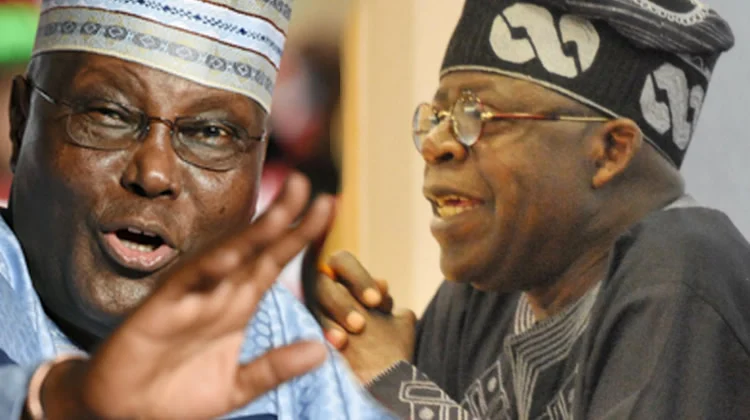
*Why Tinubu’s approach was wrong, Critics back Atiku
By KEMI KASUMU
Critics of the Tinubu’s government have defended Atiku and Peter Obi’s past promise to remove subsidy as different from hardship generating method employed by the president on May 29, 2023 which has continued to be the abbatross of the nation about four years later.
The Presidency in Nigeria has criticised former Vice President Atiku Abubakar’s proposal to restore petrol subsidies if elected president, describing the policy as fiscally unsustainable and a reversal of reforms implemented in Nigeria’s petroleum sector.
In a statement issued on Thursday August 20, 2026 by the Special Adviser to President Bola Ahmed Tinubu on Information and Strategy, Bayo Onanuga, the Presidency accused Atiku of abandoning his previous position on fuel subsidy removal in pursuit of political support ahead of the 2027 general elections.
Critics of the Tinubu’s government have defended Atiku and Peter Obi’s past promise to remove subsidy as different from hardship generating method employed by the president on May 29, 2023 which has continued to be the abbatross of the nation about four years later.
The Presidency had said Atiku, who opposed the continuation of petrol subsidies during the build-up to the 2023 presidential election, had now changed position by proposing the return of what it described as an expensive and corruption-prone system.
According to the statement, Nigerians deserve to know how any proposed subsidy regime would be financed, particularly under the current petroleum-market structure.
Onanuga argued that petrol subsidy was not simply free money kept in government coffers for distribution to Nigerians, but represented the difference between the cost of supplying petrol and the regulated pump price.
He said the former arrangement placed significant financial pressure on the government, with subsidy-related obligations accumulating over time.
The Presidency also rejected Atiku’s claim of a N30 trillion subsidy windfall or savings, saying such funds do not exist as cash available to the government.
It maintained that the Petroleum Industry Act (PIA) had already provided for the removal of petrol subsidy by the end of June 2023, while President Tinubu accelerated the process by announcing the removal shortly after assuming office.
The Presidency said Nigeria’s petroleum industry has undergone significant changes since the subsidy regime was dismantled, particularly with the emergence of large-scale domestic refining.
It highlighted the Dangote Refinery as a major development capable of supplying petrol locally and reducing the country’s dependence on imported refined petroleum products.
The statement argued that restoring the old subsidy model could undermine investments in domestic refining and discourage further development of local petroleum production.
It also said Nigeria was increasingly moving towards a model in which crude oil is processed domestically rather than relying heavily on imported refined products.
According to the Presidency, the shift could help conserve foreign exchange, strengthen energy security, create jobs and support industrial development.
The statement challenged Atiku to explain how a restored subsidy would be financed.
It asked whether the Federal Government would borrow to fund the programme, divert money from infrastructure and social services, reduce allocations to states and local governments, or increase public debt.
The Presidency also questioned what exactly a new subsidy would cover in a petroleum market where domestic refining capacity has expanded.
“If petrol is sold below its economic cost, someone must absorb the difference,” the Presidency said, arguing that the ultimate burden would fall on public finances.
It further called for clarity on the proposed pump price and the estimated annual cost of the policy.
While acknowledging the hardship caused by higher petrol prices, the Presidency said the Tinubu administration was pursuing alternative measures aimed at reducing transportation and energy costs.
It pointed to the government’s promotion of Compressed Natural Gas (CNG), which it said could provide a significantly cheaper energy source for taxis, cars and distribution vehicles.
The Presidency noted that major companies, including Dangote and BUA, had also introduced CNG-powered trucks into their fleets.
It argued that expanding the adoption of CNG could provide more sustainable relief to Nigerians than returning to a subsidy system that government says previously drained public resources.
The Presidency said Atiku had the constitutional right to propose alternative economic policies but insisted that any promise to restore fuel subsidy must be accompanied by clear fiscal and legal details.
It challenged the former vice president to disclose the projected annual cost of the programme, its funding source, whether borrowing would be required and whether amendments to existing petroleum legislation would be necessary.
The Presidency also demanded details on how subsidy payments would be monitored and protected against the abuses associated with the former regime.
It urged Nigerians to assess the proposal against the realities of the country’s current petroleum market rather than the conditions that existed before 2023.
The statement concluded by calling for a robust national debate on the cost of living and economic policy but warned against returning to policies whose financial consequences could later emerge as debt, reduced public spending and further pressure on the naira.
Why Tinubu’s approach was wrong – Critic
In several quarters, Nigerians familiar with Tinubu’s attempt to push blame of his fuel subsidy removal failure on his predecessor Muhammadu Buhari even in death are saying the president could not have been honest with such attempt.
“Did Buhari remove subsidy and push the challenges over to his successor, Tinubu? The answer is no,” said the anonymous critic who continued by asking, “What did Buhari do? He simply said ‘Alright, instead of the wasteful use of Federal Government money for subsidy that is not reaching the targeted beneficiaries that is the Nigerian masses because of activities of some self-centered independent marketers, NNPCL should now be the sole importer of fuel and use from its own earnings to pay subsidy and then distribute to major marketers who have the financial integrity to ensure diligence in selling to the public at approved subsidised rates.’
“Now, where is the subsidy removal by Buhari in that? And you hear the Tinubu government saying Buhari did not put fuel subsidy in the 2023 national budget. Buhari could not have done that. How could the same subsidy that NNPCL had taken care for, now be duplicated into the national budget? It is impossible.
“Buhari was a meticulous diligent man of integrity. All the lies being told about him that he removed subsidy should stop. Buhari did not remove subsidy from being benefited by the people but transferred responsibility for paying it to the NNPCL,” one of the critics anonymously said justifying the statement credited to Atiku Abubakar, who is the presidential candidate of African Democratic Congress (ADC) for the 2027 election.