Yoruba land under siege? How anti-Islam campaigns morphed from Christian evangelism to social-media idolatry
By SHERIFDEEN ABBAS
“Yoruba Land belongs to all Yoruba people — Muslim, Christian and traditionalist. No group should attempt to rewrite the history of another. No Yoruba Muslim should be told that Islam makes him less Yoruba. No Christian should be attacked for believing in Christianity. No traditionalist should be persecuted for practising his faith. But equally, no religious group should expect to attack another faith with impunity and demand silence in return. If the old anti-Islam campaigns failed, the emergence of a new social-media campaign should not be allowed to become another chapter in Nigeria’s long history of religious provocation.”
For years, Muslims in parts of Yoruba Land have endured what many regard as religious discrimination, stigmatisation and provocative attempts to undermine their faith in schools, workplaces, hospitals and other public spaces.
But what started as Christian missionary campaigns against Islam, according to this writer, has now assumed a new and more aggressive form — this time playing out largely on social media and involving some adherents of traditional religion.
The battlefield has changed.
The weapons have changed.
But the target, according to critics of the new campaign, remains the same: Islam, the Holy Qur’an and Muslims.
In the old days, some Muslims found themselves having to defend their faith against Christian evangelists whom they accused of misrepresenting the Qur’an, Hadith and Prophet Muhammad (peace be upon him).
Today, social media has opened another front.
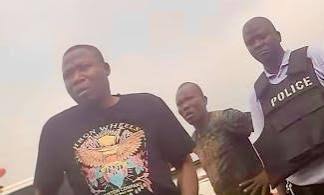
And names such as Abdulazeez Adegbola, popularly known as Tani Olohun, fully backed by Sunday Igboho against lawful police arrest of him despite evident court approved warrant have become part of the controversy.
WHEN MUSLIMS WERE TOLD: “YOUR RAM WILL TAKE YOU TO HELL”
The memories have not disappeared.
One such incident allegedly occurred around Ikeja during an Eid-ul-Kabir celebration involving members of Latter Rain Bible Church.
According to the account, church members moved into nearby communities, including Adeniyi Jones, Ogba and Adekunle Village, during the Sallah period.
The alleged message to Muslims was blunt and provocative:
“This ram you are eating will take you to hellfire.”
For Muslims who experienced such encounters, it was not harmless evangelism. It was religious provocation.
And it was precisely this atmosphere, the writer argues, that helped fuel the emergence of Islamic comparative-religion scholars and debaters who refused to remain silent.
Among those who became prominent in that intellectual battlefield was Yusuf Adepoju, popularly associated with ACADIP, an acronym for Academy of Islamic Propagation, an early 2000s graduate of Federal University of Technology (FUTA) with vast knowledge of Bible and Qur’an and Hadith aiding his religious comparative and debate activities across Nigeria and abroad.
Their strategy was simple and straightforward: when Islam was criticised, they demanded evidence; when the Qur’an was questioned, they cited relevant Islamic sources; and when Christian arguments were advanced against Islam, they frequently responded by examining the Bible itself.
DEEDAT SHOWED THE WAY
Across Africa, the late Dr Ahmed Deedat demonstrated the power of comparative religious debate.
Rather than responding to religious provocation with violence, Deedat confronted Christian missionaries on the intellectual battlefield — scripture against scripture, argument against argument.
That tradition influenced generations of Muslims who came to believe that Islam could be defended without surrendering to intimidation.
But the battlefield has now moved from public debates to smartphones.
THE NEW FRONT: SOCIAL MEDIA
According to the writer, traditional-religion activists have increasingly entered the same ideological space once occupied by Christian missionaries.
The difference is that social media has made it possible for anyone with a phone, microphone and audience to become a self-appointed religious authority.
Some critics accuse personalities such as AbdulAzeez Adegbola a.k.a. Tani Olohun and others of taking Qur’anic verses out of context and presenting interpretations that Muslims consider deliberately misleading.
The result is a new religious confrontation — one in which TikTok, Facebook, YouTube and other platforms have become virtual battlefields.
And the danger is obvious.
When sacred texts are deliberately distorted for clicks, followers and influence, religion becomes entertainment.
When religious insults become content, outrage becomes currency.
And when historical grievances are mixed with ethnic politics, the consequences can become explosive.
THE STRANGE ALLIANCE
There is, however, what the writer considers a striking contradiction.
Christianity rejects idolatry.
Islam rejects idolatry.
Yet whenever traditional-religion activists and Muslims clash, some Christian actors appear, in the writer’s view, to sympathise with the traditionalists – in open display of mischief – against the Muslims.
That, the writer argues, raises an uncomfortable question:
How can people who claim to follow a faith that rejects idol worship become allies of idol worshippers simply because both groups oppose Muslims?
It is a contradiction that deserves serious examination.
FROM PERSIAN EMPIRE TO ISLAMIC REPUBLIC OF IRAN
History itself provides an extraordinary irony.
The Persian Empire of the seventh century followed Zoroastrian religious traditions and fought against the Christian Byzantine Roman Empire.
The Qur’an referred to the Roman-Persian conflict in Surah Ar-Rum and foretold a reversal of the Roman defeat.
Centuries later, Persia not only became predominantly Muslim but also changed from the ancient name of the Persian Empire to Iran.
Modern Iran, which started off as a monarchy state, eventually became the Islamic Republic of Iran after the 1979 revolution.
The historical lesson is unmistakable: societies and religious identities change.
Those who are enemies today may become allies tomorrow.
Those who consider another religion foreign today may discover that history has already overtaken their argument.
YORUBA MUSLIMS ARE NOT STRANGERS
This is where the argument returns to Yoruba Land.
For centuries, Islam has been part of Yoruba society.
Yoruba Muslims are not visitors.
They are not recent arrivals.
They are not Fulani simply because they practise Islam.
They are Yoruba.
Period.
Therefore, the argument that Yoruba Muslims should abandon Islam because it is allegedly a “Fulani religion” collapses under historical scrutiny.
Islam is not owned by an ethnicity.
A Yoruba Muslim remains Yoruba.
A Hausa Muslim remains Hausa.
A Fulani Muslim remains Fulani.
An Arab Muslim remains Arab.
The religion does not erase ethnicity.
And ethnicity does not determine religion.
THE DANGEROUS POLITICS OF INDIGENESHIP
The writer further argues that some traditional-religion activists have gone as far as questioning the indigenous status of Yoruba Muslims.
That is where religious debate can become dangerous.
Once a group begins telling another group that it does not belong, the argument is no longer merely theological.
It becomes a battle over identity, land, citizenship and political power.
And history teaches that such battles rarely end peacefully.
THE AMERICAN QUESTION
The writer also links the Nigerian religious controversy to the wider geopolitical struggle between the United States and countries such as Russia, China and Iran.
America has long faced accusations from its critics of using military, economic and diplomatic power to advance its strategic interests around the world.
Iraq, Afghanistan, Libya, Syria, Sudan, Romania, Democratic Republic of Congo (DRC), Rwanda, and other countries have featured prominently in such criticism.
Washington and its allies, however, have offered security and strategic justifications for their policies.
But the debate has now moved beyond America.
The world is changing.
Russia is challenging Western dominance.
China is expanding its global influence.
Iran has survived decades of American sanctions and pressure.
And countries in Africa are increasingly looking for alternatives to traditional Western partnerships.
RUSSIA’S NEW AFRICAN FRONT
In the Sahel, Niger, Mali and Burkina Faso have deepened their cooperation through the Alliance of Sahel States (AES).
Their relations with France and other Western powers have deteriorated sharply, while Russia has expanded its influence.
Supporters see Moscow as an alternative partner.
Critics see another form of geopolitical competition.
Either way, one thing is clear:
Africa is no longer willing to accept the old geopolitical script without questioning it.
IRAN’S DEFIANCE
Iran has become one of the most important symbols of that changing world order.
Despite decades of sanctions and pressure, Tehran has retained its political independence and developed substantial military and regional capabilities.
Its confrontation with Washington has also brought Russia and China closer to the Iranian position on several strategic issues.
The implication is enormous.
The era when one superpower could dictate the direction of the entire international system is increasingly being challenged.
AND THEN CAME THE SOCIAL-MEDIA WAR
Against this global background, religious disputes in Yoruba Land may appear small.
They are not.
A video can reach millions.
An insult can travel across continents within minutes.
A deliberately distorted Qur’anic quotation can be reproduced thousands of times before scholars even respond.
A provocative statement can turn a theological disagreement into an ethnic confrontation.
That is why the new religious battle requires vigilance.
THE REAL DANGER
The real danger is not that Christians, Muslims and traditionalists disagree.
They will disagree.
The danger begins when disagreement becomes hatred.
When history becomes propaganda.
When ethnicity becomes a weapon.
When religion becomes a political mobilisation tool.
And when social media becomes the megaphone for misinformation.
FINAL WARNING
Yoruba Land belongs to all Yoruba people — Muslim, Christian and traditionalist.
No group should attempt to rewrite the history of another.
No Yoruba Muslim should be told that Islam makes him less Yoruba.
No Christian should be attacked for believing in Christianity.
No traditionalist should be persecuted for practising his faith.
But equally, no religious group should expect to attack another faith with impunity and demand silence in return.
If the old anti-Islam campaigns failed, the emergence of a new social-media campaign should not be allowed to become another chapter in Nigeria’s long history of religious provocation.
The answer is knowledge.
The answer is evidence.
The answer is scholarship.
The answer is peaceful debate.
But those who deliberately turn religion into a weapon should remember one thing:
You may start a religious war believing you can control its direction. History has repeatedly shown that you may be the first to be consumed by the fire you started.
In Yoruba Land, the battle over faith has entered a new era. And this time, the battlefield is everyone’s smartphone.