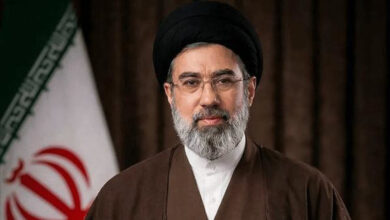
The man who should not be referee, By Oladimeji Bamidele
Let’s start with the simple truth: an electoral umpire must be boring. Monochrome. Predictable. Without history or heat. A referee, not a crusader.
By all means, Nigeria loves to play with fire. But every now and then, the flames reach too close to the oxygen tank, and one cannot help but ask: Do we have a national death wish? The appointment of Joash Amupitan as Nigeria’s electoral umpire is one such moment — a moment so baffling, so tone-deaf, so self-sabotaging that it feels like déjà vu from a country addicted to avoidable crises.
Let’s start with the simple truth: an electoral umpire must be boring. Monochrome. Predictable. Without history or heat. A referee, not a crusader.
Joash Amupitan is anything but. This is the same man who, in 2020, authored a legal brief declaring that Nigeria was witnessing a “Christian genocide.” Not communal violence. Not insecurity. Not targeted attacks. Genocide.
A word so heavy it can tilt a nation off its axis.
In a multi-faith country where suspicion already hangs in the air like harmattan dust, that single phrase alone should have disqualified him from ever presiding over a national election — not because he is Christian, but because he openly cast Nigeria’s conflicts along a religious line, portraying one side as victims of extermination.
How then does such a man become the guardian of a process meant to serve all sides?
Nigeria is a cauldron of identity, trauma, resentment, and delicate balances.
Every election is a Pentecost of panic and suspicion — a festival of accusations waiting to erupt. To manage this, the referee must be someone whose past is free of the kind of ideological fingerprints that politicians can turn into weapons.
But Amupitan walks into the arena pre-weaponised. His 2020 brief will be quoted on every radio station, every WhatsApp group, every campaign stage. Northern politicians will claim he is biased. Southern actors will say he is “their own.”
Every tribunal case will have one side screaming “conflict of interest!” before the ink dries.
This Is Not About Competence — It’s About Common Sense
Amupitan may be intelligent, articulate, even accomplished. But the job is not for the intelligent alone. It is for the trustable. And trust is a currency Amupitan spent long ago.
No matter how impartial he tries to be, no matter how airtight his procedures are, the ghost of that 2020 brief will sit beside him at every press conference. It will whisper at every collation centre. It will overshadow every decision.
And when — not if — the 2026 elections become competitive, his past words will become the loudest participant in the contest.
A Country That Fears the Edge Should Not Appoint Those Who Dance on It
Nigeria’s democracy is fragile, not because citizens do not vote, but because they do not believe the process is fair. We cannot afford a referee whose mere signature on a document sends a religious bloc into anxiety. We cannot afford a chairman whose neutrality will forever be second-guessed. We cannot afford to turn our elections into another chapter of religious dispute. And most of all, we cannot afford to pretend that choosing Amupitan is harmless. It is not. It is reckless. It is provocative.
It is a match thrown on dry thatch.
This is the question that refuses to go away. Why Amupitan? Why now?
Why pick the one candidate whose appointment guarantees instant distrust, instant division, instant controversy?
Is Nigeria so short on legal minds, so impoverished in talent, so starved of neutrality that we must recycle a man whose own writings undermine the job description? Of course not.
We simply refuse to learn.
Appointing Joash Amupitan as Nigeria’s electoral umpire is not just an error in judgment. It is a threat to national cohesion. It is an endorsement of avoidable tension. It is the political equivalent of handing a man a matchbox in a dry forest and saying, “Please be careful.”
Lagos, Nigeria
December 2025