Reactions as Trump, upon return from China, claims he commanded killing of ISIS ‘global second in command’ in Nigeria
*”Nigerians deserve better than recycled victories – Dr. Emman Shehu
By KEMI KASUMU with Agencies

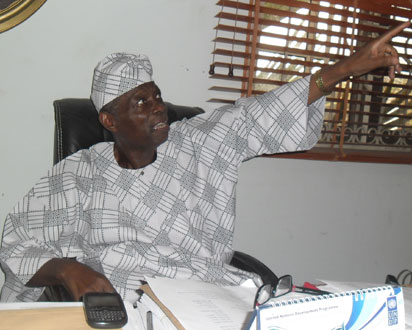
In a swift reaction, Nigerian journalism veteran, poet and Director of International Institute of Journalism Abuja, Dr. Emman Usman Shehu, faulted the Trump’s claim saying the terrorist in question was said to have been neutralized in 2024 by the Nigerian government.
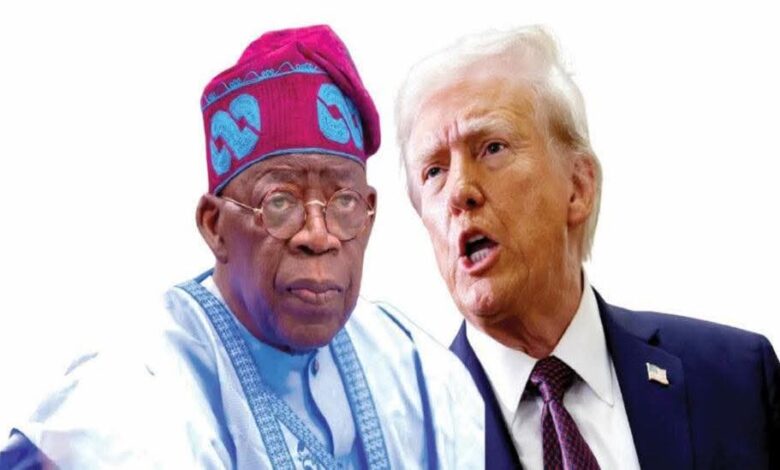
Upon his return from trip to the People’s Republic of China, believed to be generally unsuccessful as he could not get Beijing to accept his request to join in his effort to stop Iran control of the Strait of Hormuz and patronage of its oil, United States of America’s President Donald Trump has claimed that the controversial US troops presence in Nigeria has worked as the foreign soldiers, acting in cahoots with Nigerian forces, killed the “second in command” global leader of the ISIS in his ongoing war against alleged Christian genocide in the world’s largest black nation.
This medium reports that information of the development was not by Nigerian government in Nigeria but by US President Donald Trump upon his return from China where President Xi Jinping had reportedly shocked him with warning against meddling in the affairs of Taiwan, doing which was said to mean that the United States risks serious war between it and the People’s Republic.
“Tonight, at my direction, brave American forces and the Armed Forces of Nigeria flawlessly executed a meticulously planned and very complex mission to eliminate the most active terrorist in the world from the battlefield,” the US president said on his Truth Social platform on Friday May 15, 2026.
“Abu-Bilal al-Minuki, second in command of ISIS globally, thought he could hide in Africa, but little did he know we had sources who kept us informed on what he was doing,” Trump added.
Al-Minuki had been placed under US sanctions in 2023 for ties to the Islamic State group.
“He will no longer terrorize the people of Africa, or help plan operations to target Americans,” Trump said. “With his removal, ISIS’s global operation is greatly diminished.”
Trump thanked the government of Nigeria for its “partnership” on the operation, while not disclosing exactly where it took place or the form of attack involved.
Al-Minuki, a Nigerian national, was designated as a “specially designated global terrorist” by the former Biden administration in 2023, according to the US federal register. At the time the state department called him a Sahel-based IS senior leader and part of its general directorate of provinces, the group’s administrative body that provides “operational guidance and funding around the world”.
Trump has previously accused Nigeria of failing to protect Christians from Islamist militants in the north-west.
Nigeria denies discriminating against any religion, saying its security forces target armed groups that attack both Christians and Muslims.
The US carried out strikes targeting Islamic State-linked militants in Nigeria in December. Since then, Washington has deployed drones and 200 troops to provide training and intelligence support to the Nigerian military against Islamic State and al Qaeda-linked insurgencies that are spreading across west Africa.
The US forces were operating in a strictly non-combat role, Nigerian military officials said earlier this year.
In a swift reaction, Nigerian journalism veteran, poet and Director of International Institute of Journalism Abuja, Dr. Emman Usman Shehu, faulted the Trump’s claim saying the terrorist in question was said to have been neutralized in 2024 by the Nigerian government.
Shehu saw the announcement as of a hitherto self-installed world police country yet to recover from the shock he got from China, which refused to join him against his unprovoked war on Iran.
“In April 2024, Nigeria’s Defence Headquarters, under Major General Edward Buba, briefed the public on operations that had supposedly neutralised over 2,300 terrorists in the first quarter. Among the high-profile names was Abu Bilal Minuki, described as head of the Is-Al Furqan Province linked to ISWAP. The message was one of progress against a persistent threat.
“Two years later, the same individual resurfaces as the target of a high-profile joint raid. U.S. and Nigerian forces, according to the announcements, struck his compound, killing him along with lieutenants. Trump framed it as a decisive blow, crediting partnership with Nigerian forces while underscoring American resolve.
“Intelligence in insurgent zones is notoriously difficult. Fighters use aliases, decoys operate in their stead, and confirmation of death often relies on signals intelligence, human sources, or DNA that can take time to surface. It is conceivable that the 2024 claim was premature or referred to a different operative. Yet the pattern fits a broader tendency in modern conflicts where “high-value target” kills are timed for maximum political resonance.
“For the Trump administration in Washington, the 2026 announcement delivers a tangible foreign policy success at a moment when demonstrating strength against ISIS remnants matters. It retroactively bolsters the case for U.S. engagement in the Sahel and Lake Chad region, an area long viewed as a potential epicenter of jihadist resurgence.
“For Nigeria’s Tinubu government, the joint operation offers diplomatic breathing room. Nigeria faces ongoing scrutiny over its handling of insecurity, farmer-herder conflicts, and banditry. Aligning with a visible American success story reframes the country as a capable partner rather than a problem state, even as it navigates sensitivities around foreign military involvement on sovereign soil.
“The temptation is understandable. In democracies—and hybrid systems under pressure—leaders crave deliverables. A dramatic raid makes for compelling headlines and social media posts. Correcting the historical record, by contrast, risks accusations of incompetence or inflated claims. Admitting that a declared “kill” in 2024 may have been erroneous demands institutional humility that is in short supply during election cycles or periods of domestic strain.
“Nigerians deserve better than recycled victories. The Lake Chad Basin and northeast have endured years of Boko Haram, ISWAP, and splinter factions, displacing millions, disrupting agriculture, and traumatizing communities. Parents send children to school fearing abduction; farmers avoid fields riddled with improvised explosives. When officials declare decisive wins that later require revisiting, it breeds cynicism.
“This “zombie terrorist” phenomenon—leaders killed multiple times—undermines public confidence in the very institutions tasked with protection. It also complicates genuine counterterrorism. If sources and networks are incentivised to deliver convenient narratives over rigorous forensics, real threats can persist while attention shifts to the next press conference,” said Dr. Emman Shehu.