Obasanjo, Atiku, Mark, Aregbesola, Oshiomhole speak as Tambuwal warns: ‘Nigeria in peril, searching for salvation’
*Says “This is not where we expected to be”
*Obasanjo lifts the veil on 2011 Speakership battle
*As Jonathan, Mark recall turbulent but defining moments
*Atiku, Obi, Oshiomhole weigh in
*Democracy under threat in Nigeria – Fayemi
By BASHIR ADEFAKA
Beyond the tributes and recollections, the gathering underscored a sobering consensus: Nigeria’s challenges are profound, its democracy fragile — and its salvation, as Tambuwal warned, will require courage, unity and a return to principled leadership.
Nigeria’s former powerbrokers converged in Abuja on Saturday January 10, 2026, not merely to celebrate a milestone birthday, but to interrogate the state of a nation many of them once led or helped to shape.
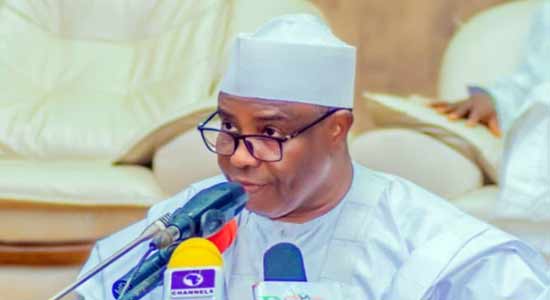
At the centre of the gathering was former Speaker of the House of Representatives and Senator representing Sokoto South, Aminu Waziri Tambuwal, who used a leadership colloquium marking his 60th birthday to issue a stark warning: Nigeria, he said, has drifted dangerously off course and now requires urgent national salvation anchored on honest leadership, responsible governance and collective resolve.
The event drew an extraordinary mix of political heavyweights cutting across party, regional and ideological lines — former President Olusegun Obasanjo, former President Goodluck Jonathan, former Vice-President Atiku Abubakar, former Senate President David Mark, former Anambra State Governor Peter Obi, former Edo State Governor Adams Oshiomhole, and former Osun State Governor Rauf Aregbesola, among many others.
Reflecting on Nigeria’s democratic journey since the return to civil rule in 1999, Tambuwal said the current state of the country represents a painful betrayal of the hopes that once animated the nation.
“Where we are today is unfortunate. This is not where we expected to be,” he said.
He invoked the memories of Nigeria’s democratic pioneers, arguing that the present condition of the country would deeply disappoint them.
“Those who laid the foundation for this democracy, some of whom are alive, many of whom are no longer living, are not happy — even in their graves — with the current situation in Nigeria.”
Tambuwal cautioned that national renewal must rise above personal ambition, ethnic sentiment and partisan rivalry, warning that democracy cannot thrive where institutions are weakened by selfish politics.
“It is about the people of this country. It is about good governance. It is not about me. It is not about money-making,” he said.
In one of the most striking moments of the event, Tambuwal declared:
“Nigeria is in peril, and we are searching for salvation. And that salvation is a collective process.”
He stressed that Nigerians have no alternative homeland and must therefore take responsibility for fixing their country.
“We are citizens of this country. We have nowhere else to go. We must remain in Nigeria and ensure that we do the right thing so that we can have the right leadership.”
Tambuwal also recommitted himself to the struggle for democratic renewal, saying he was ready to take greater personal risks in defence of the nation.
“At this point in my life, I must recommit myself to what I have always believed in — working with every Nigerian who believes in good democratic governance and in turning this country around.”
Chairman of the occasion, former President Olusegun Obasanjo, offered rare insight into the behind-the-scenes politics of the 2011 National Assembly leadership contest, explaining why he and then-President Goodluck Jonathan opposed Tambuwal’s emergence as Speaker.
According to Obasanjo, the opposition was rooted in party considerations and a desire to promote gender inclusion following the PDP’s endorsement of Mulikat Akande-Adeola.
“Our thinking was that if, for the first time, a woman had become Speaker of the House, she should be encouraged to remain there,” he said.
Despite lacking the backing of the Jonathan administration, Tambuwal — then a second-term lawmaker — defeated Akande-Adeola by 252 votes to 90, with crucial support from opposition lawmakers, particularly the defunct Action Congress of Nigeria (ACN) led by Bola Tinubu. The episode remains one of the rare moments in Nigeria’s Fourth Republic when the legislature openly defied executive preference.
Obasanjo said the presidency ultimately respected the lawmakers’ decision.
“One thing I saw in you was humility. Greatness without humility is hollow. Your greatness is not hollow,” he told Tambuwal.
Speaking virtually, former President Goodluck Jonathan acknowledged that his administration had its share of disagreements with the House under Tambuwal’s leadership, but praised his ability to command loyalty.
“When he was Speaker, I was the President, and we had some disagreements,” Jonathan said.
“But one thing I must give to Tambuwal is that members of the House believed so much in him. He held the House together.”
Former Senate President David Mark offered a lighter but revealing recollection, narrating how Tambuwal and his deputy, Emeka Ihedioha, boldly informed him of their determination to lead the House.
“They came to me and said, ‘Sir, whether you like it or not, you are adopting us as your sons,’” Mark recalled to laughter.
“They told me clearly that whether the President and the party wanted them or not, they would emerge Speaker and Deputy Speaker. For once, Mr President, I disobeyed you.”
Former Vice-President Atiku Abubakar described Tambuwal as a leader still in the making and urged him to live up to national expectations at a critical moment in Nigeria’s history.
Peter Obi, former Anambra State governor and Labour Party presidential candidate, praised Tambuwal as a bridge-builder committed to consensus, justice and national unity.
Former Edo State governor and ex-APC National Chairman Adams Oshiomhole commended Tambuwal’s skill in managing a politically fragmented House of Representatives, describing the feat as no small achievement.
Tambuwal’s 2011 rival, Mulikat Akande-Adeola, dismissed any notion of lingering bitterness.
“Only what God wills comes to pass. Tambuwal has been the Speaker and a leader. There is no animosity among us,” she said.
Former Ekiti State Governor Kayode Fayemi sounded a broader warning, noting that democracy was under strain globally, with coups and democratic reversals spreading across Africa. He urged Nigeria to jealously guard legislative independence as a bulwark against authoritarian drift.
The colloquium attracted a wide spectrum of political and civic leaders, including Senate President God’swill Akpabio (represented by Senate Minority Leader Abba Moro); Catholic Bishop of Sokoto Diocese Matthew Hassan Kukah; former Speakers Patricia Etteh and Yakubu Dogara; Senator Eyinnaya Abaribe; Minister of Housing Ahmed Musa Dangiwa; former governors Rotimi Amaechi, Aminu Masari, Udom Emmanuel, Ibikunle Amosun and Gbenga Daniel; former Deputy Speaker Emeka Ihedioha; and ADC National Secretary Rauf Aregbesola.
Beyond the tributes and recollections, the gathering underscored a sobering consensus: Nigeria’s challenges are profound, its democracy fragile — and its salvation, as Tambuwal warned, will require courage, unity and a return to principled leadership.