Nigeria will keep borrowing to fund N25.91trn budget deficit, Senate declares
By SUMAYYAH ADEFAKA
Despite growing public concern over Nigeria’s rising debt profile, the Senate has declared that the country will continue to borrow to finance its widening budget deficit, citing revenue shortfalls and pressing development needs.
The Senate also vowed to end the long-standing practice of rolling over unimplemented budgets, warning that it would no longer approve extensions of budget implementation cycles. It stressed that stricter timelines, stronger oversight and improved fiscal discipline would guide the execution of the 2026 Appropriation Act.
The Chairman of the Senate Committee on Appropriations, Senator Olamilekan Adeola (APC, Ogun West), made the position known on Tuesday in Abuja while speaking at a public hearing on the 2026 Appropriation Bill.
Adeola said borrowing had become unavoidable given Nigeria’s unpredictable revenue inflows and vast infrastructure gap, adding that the focus should be on how deficits are financed rather than borrowing itself.
“Never again will the National Assembly approve budget extensions. We must discipline our budgeting cycle, enforce strict adherence to appropriation timelines and ensure better coordination between policy design and implementation,” he said.
He noted that while public opposition to borrowing persists, Nigeria must meet its obligations to protect its credit rating and international standing. According to him, the government is deliberately limiting domestic borrowing to avoid crowding out private sector credit, while exploring alternatives such as asset optimisation, privatisation, Public-Private Partnerships (PPPs), joint ventures and Eurobond issuances.
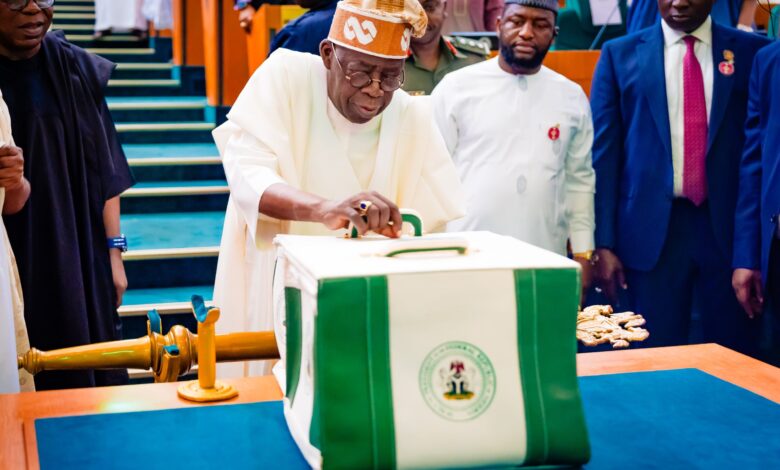
On the 2026 budget, estimated at ₦58.47 trillion, Adeola described it as a “Budget of Consolidation,” anchored on subsidy removal, tax reforms, public finance restructuring and electricity sector reforms.
He disclosed that projected revenue stands at ₦33.19 trillion, leaving a deficit of about ₦25.27 trillion. Debt service is estimated at ₦15.90 trillion, while capital expenditure of ₦23.21 trillion reflects the government’s focus on infrastructure and productivity.
Key assumptions include an inflation target of 16.5 per cent, an exchange rate of about ₦1,400 to the dollar, oil production of 1.84 million barrels per day and a benchmark oil price of $64.85 per barrel. Priority allocations include ₦5.41 trillion for defence and security, ₦3.56 trillion for infrastructure, ₦3.52 trillion for education and ₦2.48 trillion for health.
Adeola warned Ministries, Departments and Agencies (MDAs) to take budget defence seriously, noting that failure to justify proposals could result in reallocations. He also reaffirmed that all government funds, including service-wide votes, remain subject to legislative oversight.
Meanwhile, an economist and fiscal policy expert, Dr Olatilewa Adebanjo, cautioned that Nigeria’s rising budget deficit could become unsustainable without urgent reforms in revenue mobilisation and fiscal discipline. He called for stricter enforcement of the Fiscal Responsibility Act (FRA), describing it as a potent but underutilised tool.
Adebanjo also raised concerns over alleged revenue leakages in the mining and solid minerals sector, accusing foreign interests, particularly Chinese firms, of extracting Nigeria’s resources with minimal returns to the country. He further criticised what he described as unrealistic revenue projections and urged greater accountability from revenue-generating agencies.
In his remarks, the Accountant-General of the Federation, Shamseldeen Ogunjimi, criticised Nigeria’s budgeting culture, saying the country has been strong on budget formulation but weak on implementation and impact.
“A budget is a moral document. It tells us who we prioritise, what we value and how seriously we take the future of our people,” Ogunjimi said, calling for a shift from measuring success by allocations to measuring results by tangible improvements in citizens’ lives.
Declaring the hearing open, the President of the Senate, Senator Godswill Akpabio, represented by his deputy, Senator Jibrin Barau (APC, Kano North), said budget hearings were not mere rituals but moments of national self-examination.
He noted that the task of the National Assembly was not simply to spend more, but to spend better by converting appropriations into measurable outcomes that improve the lives of Nigerians.