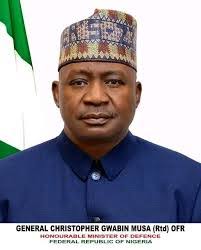
GENERAL CHRISTOPHER MUSA: Another Lost Hope for Nigeria, or a Man Exposed by Power?
By MOHAMMED BELLO DOKA
(5 August, 2026)
Less than 24 hours after Musa sat before the cameras and declared victory, the terrorists delivered a stunning rebuttal. On Thursday, September 4, 2026, suspected Boko Haram terrorists launched a brazen attack on the convoy of Mustapha Gubio, the APC governorship candidate in Borno State…This was not a soft target. This was not a defenceless village or an isolated farm. This was the convoy of a major political candidate, moving with a retinue of security agencies—soldiers, police officers, NSCDC personnel, DSS operatives, Civilian Joint Task Force members, and vigilante groups.
When President Bola Tinubu sacked General Christopher Musa as Chief of Defence Staff in October 2025, Nigerians across religious and regional lines erupted in outrage. Muslims who were the primary victims of banditry in the Northwest had found a champion in Musa, a general whose “no negotiation with terrorists” stance resonated deeply with communities ravaged by violence. His brief but public disagreement with Northern governors who favoured negotiating with bandits only solidified his image as a man of principle.
The nationwide outcry was so overwhelming that Tinubu, in a rare act of political responsiveness, appointed Musa as Minister of Defence. The appointment was met with hope, relief, and excitement unprecedented in nearly three years of the Tinubu administration. Nigerians from the Niger Delta to the Middle Belt, Christians and Muslims alike, celebrated what they saw as a choice of competence over convenience. Southern Kaduna journalists lauded the appointment. Civil society organizations commended the President. For a brief moment, Musa was not just a general; he was a symbol of renewed hope for a nation exhausted by insecurity.
But hope, as Nigerians have learned too painfully, is a fragile currency.
Musa’s tenure as Defence Minister did not deliver the expected results. In November 2025, Brigadier General Musa Uba, Commander of the 25 Task Force Brigade, was captured and executed point-blank by ISWAP terrorists in Borno State. In March 2026, the military lost three Lieutenant Colonels in a single week. That same month, terrorists overran military bases in Ngoshe and Pulka, killing at least 14 soldiers. In April 2026, Brigadier General O.O. Braimah was killed in a midnight assault. Mass abductions became routine. In November 2025, 24 female students were kidnapped from a government girls’ school in Kebbi State. In July 2026, 39 pupils and teachers were abducted from three schools in Oyo State. The Muslim Rights Concern (MURIC), which had once been among his supporters, issued a 14-day ultimatum demanding he resign or stop the killings in Sokoto, where at least 43 people and an Imam had been killed in just three weeks.
Then came two statements that would seal his fate.
On September 3, 2026, during an interview on Channels Television’s Politics Today, Musa declared that Nigeria had defeated terrorism. “Frankly speaking, we have defeated terrorists,” he said, arguing that attacks were no longer as rampant. “Maybe if you noticed, you don’t hear so much of Boko Haram attacks, ISWAP attacks and all these things here and there, maybe one off,” he insisted. He claimed that the security situation had improved considerably under President Tinubu. He acknowledged that kidnapping remained a major concern but bizarrely described it as “a social ill where you now see wives kidnapping husbands and husbands kidnapping children”.
The claim was extraordinary. It was also demonstrably false. Nigerians do not need to consult security reports to know that terrorists have not been defeated. They know it from the villages razed, the children stolen, the soldiers killed, and the generals buried. They know it from the barracks ransacked and the military bases overrun. They know it because they live it every single day. For a Defence Minister to stand before the nation and declare victory while the bodies of soldiers and civilians continue to pile up was not just delusional—it was an insult to every Nigerian who has lost a loved one to terrorism.
Less than 24 hours after Musa sat before the cameras and declared victory, the terrorists delivered a stunning rebuttal. On Thursday, September 4, 2026, suspected Boko Haram terrorists launched a brazen attack on the convoy of Mustapha Gubio, the APC governorship candidate in Borno State. The convoy was travelling along the Gubio-Kareto-Damasak highway in northern Borno, returning to Maiduguri after a thank-you visit to party members. This was not a soft target. This was not a defenceless village or an isolated farm. This was the convoy of a major political candidate, moving with a retinue of security agencies—soldiers, police officers, NSCDC personnel, DSS operatives, Civilian Joint Task Force members, and vigilante groups. The terrorists laid an ambush, planting Improvised Explosive Devices on the road and firing several Rocket Propelled Grenades at the convoy. A police armoured vehicle leading the convoy ran over one of the landmines and was severely damaged in the blast. Fortunately, no casualties were recorded, as the security forces were able to repel the attackers. But that is precisely the point. If Boko Haram has been defeated, as the Minister of Defence so confidently declared, how did they muster the resources, the intelligence, and the sheer audacity to launch a coordinated ambush on a heavily fortified convoy? How did they plant landmines, fire RPGs, and engage security forces in a firefight—all within 24 hours of the Minister’s declaration of victory? If they have the effrontery to attack such a highly protected convoy, moving with the full weight of Nigeria’s security apparatus, what does that say to the common man? What does it say to the farmer in Borno who cannot sleep without fear, to the mother in Katsina who dreads the knock on her door, to the student in Kebbi who was kidnapped from her school just months ago? If the most powerful and well-protected figures in the land are not safe, then no one is safe. If Boko Haram can ambush a candidate’s convoy with IEDs and RPGs, then the defeat the Minister speaks of exists only in his imagination.
But Musa was not done. On that same interview, he launched an extraordinary attack on former Kaduna State Governor Nasir El-Rufai. “El-Rufai did a lot of terrible things in Kaduna State. He divided the state into two,” Musa alleged. He accused El-Rufai of “deliberately planning the killing of people in Southern Kaduna”. He claimed that El-Rufai had openly boasted about paying bandits: “He told us he paid bandits. He told us he did this; he did that. He didn’t hide it”. He described El-Rufai not as an enemy but as “misguided”.
For a sitting Minister of Defence to level such allegations against a former governor was political dynamite. Retired Major General Danjuma Hamisu Ali-Keffi, a former General Officer Commanding 1 Division, expressed his profound disappointment. He accused Musa of politicising the claims and challenged him to provide evidence. “Generals should be very careful how we comment on political issues. We are not professional politicians. We should leave politics for politicians,” Ali-Keffi said. Coming from a retired general who had served alongside Musa, the criticism was devastating.
The question that now haunts every observer is this: has power exposed Christopher Musa, or has power corrupted him? Was he always this man—a man willing to sacrifice his credibility for political advantage—or did the allure of power and position transform him? Did the man who once stood as a symbol of national unity lose himself in the corridors of power?
The timing of Musa’s comments is deeply suspect. The All Progressives Congress finds itself in a desperate situation. El-Rufai is currently embroiled in legal battles over allegations of abuse of office, financial misconduct, and fraud. His supporters have even hired a United States-based lobbying firm to raise concerns about his prosecution. In this context, Musa’s attack on El-Rufai reads less like principled outrage and more like a calculated political hit job. Was he trying to distract Nigerians from the drug trafficking investigation involving the APC in the United States? Was he desperately trying to protect his position? Or was he attempting to ingratiate himself with Governor Uba Sani, who has made political moves to distance himself from El-Rufai’s legacy? Musa himself credited Sani with dissolving the “toxic” situation he blamed on El-Rufai. The alignment is too convenient to be coincidental.
Whatever the motivation, Musa has succeeded in achieving the opposite of what he intended. His declaration that Boko Haram has been defeated has alienated Nigerians who know the truth. His attack on El-Rufai has alienated the very Muslims who once supported him. MURIC, already critical of his security record, now views him with deepened suspicion. The Northern political class sees his attack on a prominent Northern Muslim politician as a politically motivated assault. The cross-religious, cross-regional, cross-party support that once defined his public image has evaporated.
The consequences for the APC in Kaduna State will be dire. Muslims form an overwhelming majority of Kaduna’s population. By attacking a Muslim former governor and aligning himself with a governor who has ended the Muslim-Muslim ticket in the state, Musa has effectively pitched the majority of Muslims against the APC. In a state where religion has long shaped electoral politics, this is political suicide.
General Christopher Musa began his political journey as a symbol of hope—a man who could unite Nigerians across divides, a general who would finally confront the terrorists and bandits plaguing the nation. He ends it as a cautionary tale. Power did not make him a better man; it exposed him. It revealed a politician willing to sacrifice his integrity, his credibility, and his legacy for short-term political gain. And in doing so, he has not only destroyed his own reputation but may have dealt a fatal blow to his party in a state that matters most.
The hope is lost. What remains is a man exposed by power—and a nation left to wonder what might have been.
*Mohammed Bello Doka can be reached via bellodoka82@gmail.com