{EDITORIAL} The Niger 37: For what crimes were they killed?
MAIN POINT: The Nigerian citizen must not be left with nowhere to turn
And so, the question remains painfully simple: For what crime were they killed? If they were suspected of illegal mining, then let them face the law. If they were guilty, let a competent court determine their guilt and impose the punishment prescribed by law. But if they were merely suspects, why did 37 human beings who entered government custody alive end up dead? That is the question Nigeria must answer.
There are moments in the life of a nation when the circumstances surrounding the death of citizens demand more than condolences, press statements and promises of investigation.

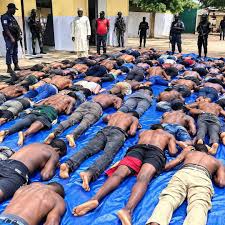
The deaths of 37 suspected illegal miners in the custody of the Nigeria Security and Civil Defence Corps (NSCDC) in Minna, Niger State, are one such moment.
On September 17, 2026, 37 detainees reportedly died after being arrested during anti-illegal-mining operations in the M.I. Wushishi and Lukoto areas of Niger State on September 15 and 16. The NSCDC initially attributed the deaths to a suspected disease outbreak, while survivors and relatives later raised allegations concerning overcrowding, poor ventilation and mistreatment. The precise cause of death remains under investigation.
And so, the question remains painfully simple: For what crime were they killed? If they were suspected of illegal mining, then let them face the law. If they were guilty, let a competent court determine their guilt and impose the punishment prescribed by law.
But if they were merely suspects, why did 37 human beings who entered government custody alive end up dead?
That is the question Nigeria must answer.
Illegal mining is not a death sentence
There is no argument here for illegal mining. Nigeria’s mineral resources belong to the Nigerian people, and the illegal exploitation of gold, lithium and other minerals can damage communities, deprive government of revenue and, in some circumstances, feed criminal networks.
The government therefore has every right—and indeed a responsibility—to enforce the law against illegal mining. But enforcement cannot mean abandoning the principles of justice.
A suspect is not a convicted criminal. An arrested person is not a person sentenced to death. And detention is not a licence for the state or its agents to expose citizens to conditions that may result in their deaths.
That is why the Niger 37 tragedy must not be reduced to the question of whether they were illegal miners.
Even if every one of them had been guilty, the fundamental question would remain: under what circumstances did 37 people die in state custody?
What happened inside that facility?
This is where the independent investigation becomes critical.
The Federal Government has constituted a 10-member independent committee to investigate the deaths, following President Bola Tinubu’s directive for a comprehensive, transparent and unhindered investigation. Officers involved in the incident, including the Niger State NSCDC commandant, have been suspended pending the outcome of the investigation.
Niger State Governor Mohammed Umaru Baggo also confirmed that 37 people died in NSCDC custody and said forensic examinations, medical examinations and autopsies were being pursued to establish the scientific cause of death.
That investigation must answer questions that ordinary Nigerians are asking. How many people were detained? What was the capacity of the cell? How long had the detainees been inside? Were all of them teenagers or were people of different ages among them? What medical attention did they receive? Were there signs of illness before they died? Was there adequate ventilation? Were the detainees beaten or otherwise mistreated? Were the required detention procedures followed? And, most importantly, could these deaths have been prevented?
These are not questions of politics. They are questions of humanity.
The tragedy of Nigeria’s mineral wealth
There is another dimension that Nigerians must not ignore.
Nigeria is immensely blessed with natural resources. Yet communities sitting on valuable deposits frequently experience poverty, insecurity and underdevelopment.
Meanwhile, minerals extracted from Nigeria can find their way into international supply chains, while the country struggles to capture the full economic value of its resources.
This is why the campaign against illegal mining must be broader than arresting poor young Nigerians at mining sites. Who finances the operations? Who provides the equipment? Who purchases the minerals? Who moves them from the mining communities? Who takes them across borders? Who ultimately makes the biggest money?
These questions matter because it would be an injustice if the young and vulnerable people at the bottom of the chain were repeatedly arrested and detained while the powerful commercial networks benefiting from the mineral trade remain untouched.
The government must therefore pursue the entire chain—not merely its most vulnerable participants.
The other Niger tragedy
What makes the situation even more painful is that the same Niger State has recently witnessed another horrifying security crisis.
On August 21, 2026, armed men attacked communities around Dekara in Borgu Local Government Area and abducted worshippers during Friday prayers. Contemporary reports initially gave no confirmed figure for the number taken; later reports and a video circulated by residents suggested that the number could have been several hundred. The authorities did not initially verify the larger figures.
That incident was particularly disturbing because people were attacked while engaged in Islamic worship.
It demonstrated yet again how vulnerable ordinary Nigerians have become in communities where criminal groups can operate with terrifying confidence.
And this is where the two tragedies meet. On one side, citizens are vulnerable to armed criminals and terrorists. On the other, citizens taken into government custody must also be protected by the institutions of the state.
The Nigerian citizen must not be left with nowhere to turn.
Where is the international outrage?
There is also a legitimate question about international attention.
Nigeria’s insecurity is frequently discussed in international political and religious circles. Foreign governments, international organisations, politicians, religious commentators and advocacy groups regularly comment on violence in Nigeria.
Yet Nigerians should demand that every concern about Nigerian lives be guided by the same principle:
A Nigerian life is a Nigerian life.
Whether the victim is Muslim or Christian, Northern or Southern, Hausa, Yoruba, Igbo, Fulani, Kanuri, Nupe or any other Nigerian identity, the value of that life should not depend on which political or religious narrative it fits.
That is why Nigerians who were previously demanding statements from foreign leaders and Christian commentators over violence against Christians should also be prepared to demand attention when Muslim Nigerians are killed, abducted or abused.
The reverse should be equally true.
Nobody should need to belong to a particular religion before his suffering becomes worthy of international concern.
Nigeria cannot survive selective outrage
This is not an argument against Donald Trump, Benjamin Netanyahu, Mike Arnold or any other foreign personality speaking about Nigeria.
It is an argument for consistency.
If somebody claims to care about the protection of Nigerian Christians, that concern should not disappear when the victims are Muslims.
And if somebody claims to care about Nigerian Muslims, that concern should not disappear when Christians are victims.
Human suffering should not be filtered through religious identity before it becomes worthy of condemnation.
The Niger 37 therefore should not become a Muslim-versus-Christian argument.
They should first be remembered as 37 human beings who died in government custody.
The victims of the Borgu attack should likewise be remembered as Nigerian citizens whose right to life and worship was violated.
Condemnation is not enough
Nigeria has become accustomed to the language of official grief.
A tragedy happens.
A ministry issues a statement.
A governor expresses sadness.
A politician calls for calm.
A committee is inaugurated.
And then, after the cameras leave, the country moves on.
This cycle must end.
The Niger 37 deserve something more than condolences.
Their families deserve answers.
If officials are found responsible, they deserve prosecution.
If negligence is established, those responsible must face the consequences.
If the deaths resulted from overcrowding or other unlawful detention conditions, the responsible institutions must be held accountable.
If the investigation establishes a different cause, the evidence must be made public.
And if there was criminal conduct, nobody should be protected because he wears a government uniform.
What kind of country do we want?
An ideal society is not one where crime does not exist.
It is one where institutions work.
It is one where a person suspected of a crime can be arrested without being unlawfully tortured.
It is one where a suspect receives medical attention when necessary.
It is one where courts determine guilt.
It is one where security agencies protect citizens rather than become another source of fear.
It is one where mineral resources are properly regulated and the benefits reach the Nigerian people.
It is one where international partners who benefit from Nigeria’s resources are also held to standards of transparency and accountability.
And it is one where the death of 37 young Nigerians cannot be buried beneath a government press release.
The Niger 37 should therefore become a turning point.
Not because Nigerians should abandon the fight against illegal mining.
Not because criminals should be permitted to exploit the country’s mineral wealth.
But because the fight against crime must itself obey the law.
Nigeria must protect its citizens from terrorists, bandits and criminal networks.
But the state must also ensure that those it arrests remain safe until the law determines their fate.
That is the difference between government and lawlessness.
And that is ultimately what the Niger 37 are asking us, even in death:
If we were accused of a crime, why were we not given the chance to face the law?
Nigeria owes their families an answer.