AY4TJ Webinar Examines Colonial Legacies and Youth-Led Pathways to Peace in the Great Lakes Region
By KAMAL OLOLADE AHMED
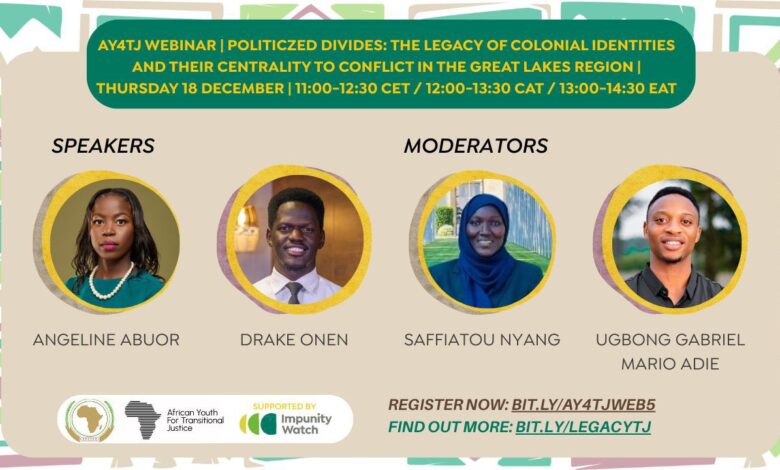
An online webinar convened by the African Youth for Transitional Justice (AY4TJ) has reignited debate on how colonial-era identities continue to shape conflict dynamics in Africa’s Great Lakes region, while spotlighting the critical role of youth in advancing inclusive and preventive transitional justice processes. The webinar which is the 5th in the legacy policy brief series by the AU-affiliated African Youth for Transitional Justice (AY4TJ) in collaboration with Impunity Watch.
Moderated by Gabriel-Mario Ugbong, the session brought together practitioners, legal experts, and youth advocates to interrogate the enduring impacts of colonial governance structures on contemporary violence. The discussion drew on previous AY4TJ policy briefs on youth participation in reparations in Ethiopia and intergenerational justice in South Africa, reinforcing a central theme of the series: young people are not passive beneficiaries of justice mechanisms but active shapers of peace and accountability.
Opening the webinar, Ugbong welcomed participants and announced the availability of simultaneous English and French interpretation, reflecting the organisation’s commitment to accessibility across linguistic divides. He recapped earlier sessions that explored youth-sensitive reparations and intergenerational trauma, before introducing the day’s focus on inherited and institutionalised identities in the Great Lakes region.
Enya, Chairperson of AY4TJ, described the session as the culmination of a journey that began with centring youth voices in reparations debates and expanded across multiple African contexts. He highlighted AY4TJ’s partnership with Impunity Watch and the African Union, noting that the series consistently advanced the idea of youth as agents of change within transitional justice frameworks.
To ground the discussion, Ugbong introduced a contextual video by Samueli Shemue on Rwanda’s 1994 genocide, which examined how colonial categorisations of Hutu, Tutsi, and Twa hardened social distinctions and transformed identity into a determinant of power, exclusion, and survival. The video underscored a core argument of the session: that identity, once institutionalised, can become a tool of violence.
The discussion was later guided by Safiya Nyang, a legal practitioner specialising in transitional justice, human rights, anti-corruption, and gender justice. Nyang congratulated the authors of the featured policy brief—Angeline Abuor, a human rights lawyer and development practitioner, and Douglas Drake Onen, a human rights and transitional justice advocate—before steering the conversation toward the historical roots and contemporary consequences of inherited divides.
Presenting her analysis, Abuor challenged the dominant narrative that portrays conflicts in Rwanda and Burundi as the product of ancient ethnic hatred. She argued that while social distinctions existed prior to colonisation, they were largely fluid and based on occupation rather than rigid ethnic hierarchies. Colonial administrations, particularly under Belgian rule, she explained, institutionalised and politicised these differences through identity cards, censuses, and unequal access to education and governance.
“What colonialism did was not simply create divisions from nothing,” Abuor noted, “but entrench and weaponise existing social differences by favouring one group over another, thereby amplifying grievances.” In Rwanda and Burundi, she added, identity became a gateway to opportunity or exclusion, laying the groundwork for mass violence.
Douglas Drake expanded the analysis to the Democratic Republic of Congo (DRC), situating the country at the centre of regional insecurity. He traced Congo’s instability to its colonial past, beginning with King Leopold II’s extractive administration and later Belgian rule, which deliberately limited education and elite formation among Congolese populations. By the time of independence in 1960, the country had fewer than 20 university graduates, creating what Drake described as a “leadership vacuum” that persists today.
Drake linked this historical marginalisation to the First and Second Congo Wars and to ongoing conflicts in eastern DRC, often simplistically attributed to mineral extraction. He argued that the deeper roots lie in weak institutions, politicised identities, and the spillover effects of the 1994 Rwandan genocide, when armed groups and displaced populations crossed into eastern Congo, reshaping the region’s security landscape.
Returning to the Rwandan case, Abuor emphasised how post-independence leaders inherited and maintained colonial administrative systems rather than dismantling them. These systems continued to politicise ethnicity and exclude segments of the population, culminating in the 1994 genocide, when identity itself became, in her words, “an instrument of death.” She noted that Burundi followed a similar trajectory, marked by cycles of coups and violence despite peace agreements such as the Arusha Accords, which addressed some political issues but left deeper grievances unresolved.
At the heart of the webinar was the policy brief presented by Abuor and Drake, which calls for youth-led initiatives to confront inherited divides and advance inclusive, equitable governance across the Great Lakes region. The authors argued that addressing historical injustices is not only a matter of post-conflict reconciliation but a preventive strategy essential to sustainable peace.
The session concluded with a shared recognition that without confronting the legacies of colonial identity-making and meaningfully engaging young people, efforts to build lasting peace in the region will remain incomplete.