Israel’s Parliament Inaugurated as Eisenkot Struggles to Form Government
*Netanyahu Retains Caretaker Role as Coalition Talks Continue
*Eisenkot’s Allies Introduce Bills Targeting Netanyahu-Era Policies
“You must do everything to avoid a repeat election. Reach out a hand for compromise, even between rivals… Look upon one another with generosity. There is much work to be done here, and it requires the ability and experience found in every part of this House,” said Israeli President.
Israel’s parliament was inaugurated on Tuesday, November 10, 2026, without a new government in place, following a deadlocked general election that stripped Prime Minister Benjamin Netanyahu of his parliamentary majority but left his main political rivals without a clear path to power, according to Reuters

Lawmakers elected in the October 27 general election took their oaths of office as former military chief Gadi Eisenkot sought to form a governing coalition after President Isaac Herzog tasked him with the responsibility on Sunday November 8, 2026.
However, Eisenkot and his allies also lack a parliamentary majority and have yet to reach agreements with other parties that could enable them to form a government. If both Eisenkot and Netanyahu fail to secure the necessary support, Israel could be forced into another election.
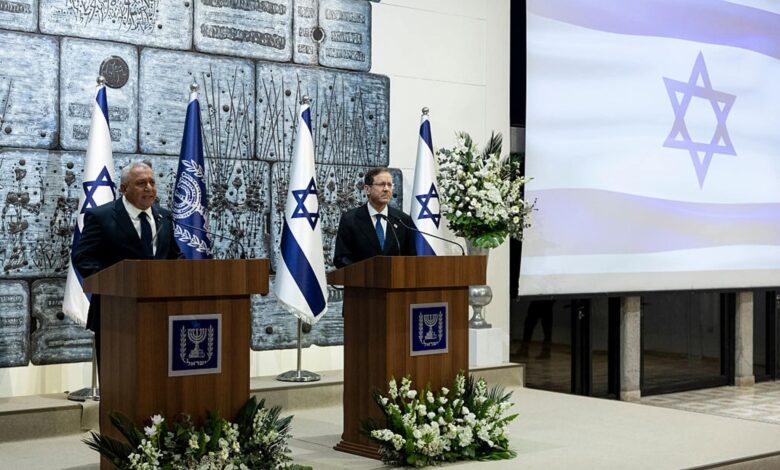
Presiding over the inauguration ceremony, President Herzog urged lawmakers to avoid another election.
“You must do everything to avoid a repeat election,” he said.
“Reach out a hand for compromise, even between rivals… Look upon one another with generosity. There is much work to be done here, and it requires the ability and experience found in every part of this House.”
Netanyahu remains caretaker prime minister until a new candidate succeeds in forming a coalition government.
His right-wing Likud party’s alliance with far-right and ultra-Orthodox parties performed better than expected in the election but still lost its parliamentary majority, securing 53 of the Knesset’s 120 seats.
Eisenkot’s centre-right Yashar party and its allied factions control 48 seats. However, they have potential support from Israel’s Arab-led parties, which hold 19 seats and share his strong opposition to Netanyahu.
The parliamentary arithmetic means the newly inaugurated Knesset could still advance some of Eisenkot’s campaign promises, including establishing a commission of inquiry into the October 7, 2023 Hamas attacks. The proposal has the backing of Arab parties but faces strong opposition from Netanyahu.
The new parliament could also replace the current Knesset speaker, who belongs to Likud.
Addressing lawmakers, Herzog said parliament was “duty bound to leave no stone unturned” in investigating and understanding the “catastrophe” of October 7, even as Israel continues to face security threats from Iran and its regional allies.
Eisenkot initially has until December 6 to form a government, although he can request a two-week extension until December 20. He has acknowledged that his chances of securing power are “extraordinarily complex”.
His options include forming a minority government with the support of Arab parties, bringing ultra-Orthodox parties into his coalition despite years of mutual hostility, or negotiating a national unity government with Netanyahu. Each option faces significant political obstacles.
The ultra-Orthodox parties have so far indicated that they would not join an Eisenkot-led administration.
Netanyahu has cast doubt on the election results by alleging voter fraud involving Arab voters, who constitute about one-fifth of Israel’s population.
However, election officials have said that although they are investigating possible misconduct, they have found no evidence of fraud capable of affecting the overall outcome.
Speaking after the parliamentary inauguration, Netanyahu called for a national unity government, warning that Iran was seeking to revive its nuclear programme and that Israel could face increasing international pressure to accept a nuclear-armed Iran.
“Only such a (unity) government will be capable of confronting challenges of this magnitude,” he said.
If Eisenkot fails to form a government, President Herzog is expected to give Netanyahu an opportunity to assemble a coalition. Should he also fail, another candidate could be given the chance before the country is compelled to hold another election.
Shortly after the official opening of parliament, Eisenkot and his allies submitted several legislative proposals, including a bill seeking to establish a state commission of inquiry into the October 7 attacks and another proposing term limits for the prime minister.
They also introduced proposals to repeal the controversial judicial overhaul and other laws enacted during Netanyahu’s administration over the past four years.
Among those sworn into office was Elisha Madan, a military reservist who lost both legs while fighting in Gaza. He received a standing ovation from lawmakers as he rose on his prosthetic legs to take the oath of office.