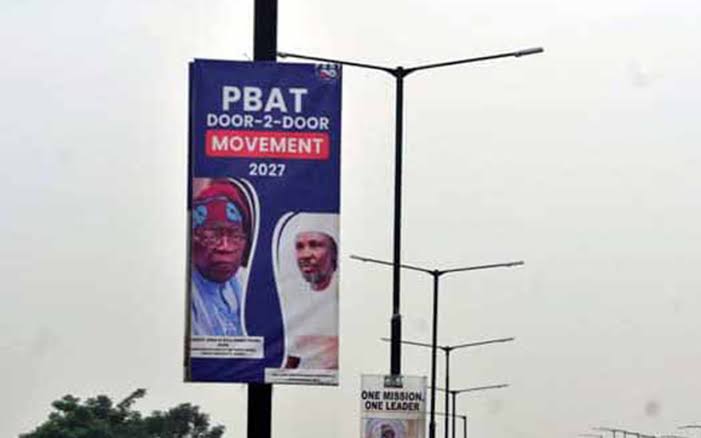
{OPINION} That only Tinubu and other APC contestants’ posters are visible in Lagos makes President’s acclaimed base unsafe for true democracy
MAIN POINTS:
*Lagos and the test of democratic freedom
*The President’s political base must set an example
*The danger of intimidation and political violence
*INEC and the responsibility to protect competition
*The 2027 elections must be about the people

By ABANIKANDA OLUMORO (UK)
Lagos State authorities should make applicable rules on campaign posters and public advertising clear, accessible and consistently enforced. Where permits or payments are required, the same rules should apply fairly to all parties. Where particular locations are restricted, such restrictions should be transparent and politically neutral.
The visibility of political campaign posters in a democracy should never be a privilege reserved for members of the ruling party. Rather, it should reflect the constitutional rights of citizens to participate in political activities, promote their preferred candidates and persuade voters to support their programmes without fear of intimidation, harassment or violence.
Against this background, the apparent dominance of President Bola Ahmed Tinubu and other All Progressives Congress (APC) contestants’ posters in Lagos State raises questions that deserve serious attention ahead of the 2027 general elections.
Lagos is widely regarded as President Tinubu’s political stronghold. It is the state where he served as governor from 1999 to 2007 and where his political influence has remained significant long after leaving office. It is also a major commercial centre whose political atmosphere inevitably attracts national attention.
However, the question confronting Nigerians is this: If Lagos is the acclaimed political base of the President of the Federal Republic of Nigeria, why should the visibility of opposition candidates and their campaign materials become a subject of concern?
A democracy is not measured by how many posters the ruling party can display on public streets. It is measured by whether all political parties can freely communicate their messages, organise their supporters and seek votes without intimidation or discrimination.
If the streets of Lagos appear dominated by posters of the President and other APC candidates while those of opposition parties are conspicuously absent, the circumstances deserve investigation. Such a situation should not automatically be interpreted as proof of deliberate suppression, but neither should it be dismissed without examining the conditions under which political parties operate.
The central issue is whether the political environment allows every contestant a fair opportunity to reach the electorate.
LAGOS AND THE TEST OF DEMOCRATIC FREEDOM
Lagos occupies a special place in Nigeria’s political history. Its size, economic importance, cultural diversity and electoral significance make it a critical arena for political competition.
For decades, the state has served as a battleground for competing political interests, personalities and ideologies. Its electorate comprises people from different ethnic, religious, social and economic backgrounds, many of whom have different political preferences.
That diversity should be reflected in the freedom available to political parties to promote their candidates.
The presence of APC posters across major roads, public spaces and neighbourhoods is not, in itself, evidence of wrongdoing. The ruling party has the same right as other parties to advertise its candidates, provided it complies with applicable laws and regulations.
The concern arises when the apparent dominance of one party’s campaign materials becomes part of a broader pattern in which opposition parties struggle to advertise, hold rallies, distribute campaign materials or engage voters without interference.
If opposition posters are removed, vandalised or prevented from being displayed because of political affiliation, the matter becomes more serious. If opposition candidates encounter threats or violence while campaigning, the implications for democratic participation become even more troubling.
These are questions that require evidence, investigation and accountability rather than assumptions.
Nevertheless, the authorities must understand that the perception of political exclusion can damage public confidence just as the reality of exclusion can.
A political environment in which citizens believe that only the ruling party can openly display its strength is one that demands closer scrutiny.
THE PRESIDENT’S POLITICAL BASE MUST SET AN EXAMPLE
President Tinubu’s longstanding political connection to Lagos makes the state particularly important in assessing the health of Nigeria’s multiparty democracy.
A political stronghold should not become a territory where opposing political voices are unwelcome. On the contrary, it should be a place where the ruling party demonstrates confidence in its political support by allowing competitors to operate freely.
The strength of democracy is not established by eliminating visible opposition. It is demonstrated by the willingness of those in power to accept competition under fair conditions.
If APC candidates enjoy widespread visibility because they have more supporters, greater financial resources or a more organised campaign structure, that is a legitimate subject of political competition.
But if other candidates cannot achieve comparable visibility because of threats, unlawful restrictions, selective enforcement of regulations or intimidation, the situation raises questions about equality before the law.
The distinction matters.
A political party should not be blamed merely because its posters are more numerous. Equally, opposition parties should not have to prove their loyalty to the country before enjoying the same freedoms as the ruling party.
The responsibility of the state is to guarantee a level playing field, not to determine which political party deserves the greatest public visibility.
For Lagos, the challenge is to demonstrate that the President’s political base remains open to every lawful political voice, irrespective of party affiliation.
THE DANGER OF INTIMIDATION AND POLITICAL VIOLENCE
Political competition loses its democratic character when fear begins to determine who can campaign and where.
Nigeria’s political history provides sufficient reasons to take threats against opposition participation seriously. Elections should be contests of ideas, records, policies and public confidence—not tests of which party can exercise the greatest control over public spaces.
Any credible allegation that opposition candidates or their supporters have been threatened, attacked or prevented from displaying campaign materials deserves prompt and impartial investigation.
Political posters may appear insignificant compared with the larger issues of unemployment, insecurity, infrastructure and the cost of living. Yet they represent something important: the right of a candidate to communicate with voters and the right of citizens to encounter alternative political choices.
Where posters are unlawfully destroyed or campaign activities obstructed, the consequences extend beyond damaged paper or lost advertising expenses.
Such actions, if established, can reinforce a perception that political power determines who may participate freely in public life.
That perception is especially dangerous in a country preparing for another general election.
The police, relevant electoral authorities and other responsible institutions must therefore be prepared to address complaints without partisan considerations. They should investigate alleged intimidation, protect lawful political activities and ensure that those who violate the law are held accountable.
No political party should enjoy immunity from investigation, and no opposition party should be denied protection because it challenges the ruling establishment.
INEC AND THE RESPONSIBILITY TO PROTECT COMPETITION
The Independent National Electoral Commission (INEC) has a central responsibility in safeguarding credible elections. Although the commission does not independently control every aspect of political advertising in public spaces, it must work within its statutory mandate and cooperate with relevant authorities to protect lawful electoral participation.
Political parties also have responsibilities. They must respect campaign regulations, avoid inflammatory rhetoric, discourage violence and ensure that their supporters do not destroy opponents’ materials or obstruct lawful activities.
Lagos State authorities should make applicable rules on campaign posters and public advertising clear, accessible and consistently enforced.
Where permits or payments are required, the same rules should apply fairly to all parties. Where particular locations are restricted, such restrictions should be transparent and politically neutral.
Most importantly, any claim that opposition parties are being denied access to public spaces must be investigated on the basis of verifiable evidence.
The objective should not be to manufacture controversy around the APC or to grant opposition parties preferential treatment. It should be to ensure that no contestant receives an unlawful advantage because of political affiliation.
A credible electoral process requires institutions that citizens can trust, including those who disagree with the government.
THE 2027 ELECTIONS MUST BE ABOUT THE PEOPLE
As Nigeria approaches the 2027 general elections, the country cannot afford an atmosphere in which political disagreement is mistaken for hostility or opposition activity is treated as an offence.
President Tinubu and the APC have every right to campaign, publicise their achievements and seek another mandate through the constitutional electoral process. Opposition parties have precisely the same right to present alternative candidates, criticise government policies and persuade Nigerians to support different political choices.
Ultimately, the electorate must decide.
That decision can only command confidence when voters believe that political competition is open, the rules are applied fairly and candidates are free to reach the people.
The apparent dominance of APC campaign posters in Lagos should therefore prompt a practical question: Are opposition parties freely able to display their materials and campaign throughout the state under the same rules that apply to the ruling party?
The answer should be established through evidence, not political loyalty or speculation.
If the disparity reflects differences in campaign resources and organisation, political parties must respond by improving their strategies. But if it reflects intimidation, unlawful restrictions or selective enforcement, the relevant authorities must act decisively to correct the situation.
Lagos should not be judged solely by the number of posters bearing the President’s image. Its democratic credentials should be judged by whether a candidate from any lawful political party can campaign without fear.
The President’s acclaimed political base must be safe for democracy, not merely comfortable for the ruling party.
A democracy is not truly secure when only one political voice appears to dominate public spaces; it is secure when every lawful political voice has the freedom to be heard and the people retain the power to choose.
That is the standard Lagos must uphold as Nigeria prepares for 2027.
DISCLAIMER: Opinions expressed in this article are strictly those of the author and not of The DEFENDER Newspaper.