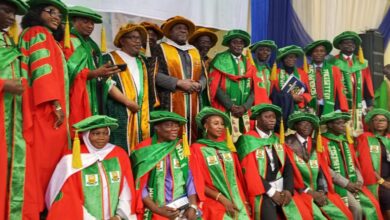
CRESCENT UNIVERSITY’S 18TH CONVOCATION: A celebration of excellence and the enduring legacy of Prince Bola Ajibola

MAIN HIGHLIGHTS:
1,008 graduates with as institution produces its first 16 PhD holders; Olowu of Owu, Yusuf Ali (SAN) and Lukman Bolaji receive honorary doctorates; Karim Foundation Hall of Residence commissioned; Rafiu Ebiti assumes office as Pro-Chancellor/Chairman Governing Council; Muhsin Ashimi is Class of 2026 Overall Best Graduating Student


By BASHIR ADEFAKA
For Prince Ajibola, the establishment of a university was not simply about constructing lecture halls, recruiting lecturers or awarding degrees. It was about creating an enduring institution capable of developing knowledgeable, disciplined and socially responsible individuals. The graduation of more than 1,000 students and the emergence of the institution’s first doctoral graduates therefore represent more than academic statistics.
Crescent University, Abeokuta, Ogun State, has recorded another significant milestone in its history with the successful celebration of its 18th Convocation Ceremony, an event that combined academic achievements, professional recognition, infrastructural development and the celebration of the enduring legacy of its founder and pioneer proprietor, the late Prince Bola Ajibola, SAN, CFR, KBE.

The two-day ceremony, held on Friday, October 16, and Saturday, October 17, 2026, at the Bola Ajibola Auditorium on the university campus, brought together graduating students, parents, academics, traditional rulers, distinguished Nigerians and other stakeholders to celebrate the institution’s contribution to higher education in Nigeria.
The convocation featured the graduation of 1,008 students, the production of the university’s first 16 Doctor of Philosophy (PhD) holders, the conferment of honorary doctorate degrees on three eminent Nigerians, the recognition of outstanding students, the investiture of a new Pro-Chancellor and the commissioning of a new hall of residence donated by businessman and philanthropist, Agbaoye Orikolade Karim.
Beyond the ceremonial significance, the occasion offered an opportunity to reflect on the vision of Prince Bola Ajibola, whose determination to establish an institution combining academic excellence with moral discipline gave birth to Crescent University, Abeokuta in 2005.
The university’s development continues to demonstrate the relevance of that vision in a society increasingly challenged by the need for quality education, responsible leadership, professional competence and ethical conduct.
The DEFENDER reports that 1,008 students graduated, including the institution’s first 16 PhD holders.
In his address at the Saturday event, Proprietor and Chairnan Board if Trustees of the Crescent University Abeokuta, Prince Muhammed Mahruf Adesegun Ajibola, SAN, FCIArb, M.IoD, said, “Except in the year 2020 when COVID-19 conditions precluded our gathering here, as it did all over the world, w have since the first convocation ceremonies in 2009 gathered here every October to celebrate, not only the achievements of this institution but also those of its proud products – our graduates; as well as their fulfilled parents. Our year-long 20th Anniversary celebration was rounded off with befitting Founder’s Day Ceremonies held in March and April this year. We have now centered the third decade of the University’s existence and we are stronger focus and reinvigorated strength, determined to see that the good reputation which thus institution has established is continually strengthened and for its Colleges to be widely acclaimed as Centres of Excellence by the time the Silver Jubilee is celebrated in 2030, In Sha Allah.”
Ajibola, who commended the honourees and new graduands, commended the university’s management for what he described as their tremendous efforts being out into running the affairs of the institution. “It is my hope and prayer that as the University enters its third decade of flourishing existence, ideas would continue to emerge that will continue to endear our institution to all and sundry.
PRINCE BOLA AJIBOLA: THE FOUNDER WHO TURNED A VISION INTO AN INSTITUTION
Any meaningful account of Crescent University’s achievements would be incomplete without acknowledging the contribution of its founder and first proprietor, the late Prince Bola Ajibola.
A distinguished Nigerian jurist, former Attorney-General of the Federation and Minister of Justice, and former judge of the International Court of Justice at The Hague, Prince Ajibola was a prominent figure in the legal profession and international diplomacy.
However, his contributions to society extended beyond law and public service. Through his commitment to education, he sought to establish an institution that would prepare young Nigerians for professional responsibilities while giving serious attention to character formation, discipline and moral values.
Crescent University emerged from that ambition. Licensed and established in 2005 following approval by the National Universities Commission, the institution has maintained its identity as a faith-based university committed to academic and moral excellence.
According to the university’s official history, the founder’s vision included producing global citizens rather than merely brilliant graduates and promoting the education of girls, particularly those who had historically faced barriers to educational opportunities.
With The DEFENDER Newspaper publishers deeply involved as media consultants to the late Crescent University’s founder to know how deeply rooted his passion for Islamic Mission for Africa (IMA) was with education at all levels at the topmost of it all, this global online newspaper can authoritatively report – over three years after his departure – that Prince Bola Ajibola established the institution to specifically produce “global citizens”, that is, graduates who possess sound academic knowledge, strong moral character, professional competence and a sense of responsibility to humanity, regardless of nationality, religion or cultural background.
He died on Saturday April 8, 2023 at the age of 89 and was buried on Sunday April 9, 2023 but his legacy remains.
This vision producing “global citizens” provides an important context for understanding the significance of the 18th convocation.
For Prince Ajibola, the establishment of a university was not simply about constructing lecture halls, recruiting lecturers or awarding degrees. It was about creating an enduring institution capable of developing knowledgeable, disciplined and socially responsible individuals.
The graduation of more than 1,000 students and the emergence of the institution’s first doctoral graduates therefore represent more than academic statistics. They reflect the continued expansion of an educational project established through the founder’s personal commitment and investment.
Although Prince Ajibola is no longer alive, the institution bearing his educational vision continues to provide a platform for young Nigerians to acquire knowledge and professional qualifications.
The responsibility before the present leadership of his eldest, Prince Muhammed Mahruf Adesegun Ajibola (SAN), is to preserve that legacy while responding to the changing demands of education, technology, research and national development.
1,008 GRADUATES AS UNIVERSITY PRODUCES FIRST 16 PhD HOLDERS
One of the major highlights of the 18th convocation was the graduation of 1,008 students across undergraduate and postgraduate programmes.
The ceremony also marked a historic achievement for the university with the graduation of its first 16 PhD holders since its establishment.
The doctoral graduates came from four departments: Accounting, Biochemistry, Computer Science and Mass Communication.
Their emergence represents an important step in the university’s postgraduate development, demonstrating its gradual expansion beyond undergraduate education into advanced research and specialised knowledge production.
The Vice-Chancellor, Professor Ibraheem Gbajabiamila, disclosed that 897 students obtained first degrees, while the remaining graduates comprised postgraduate degree and diploma recipients.
Of the undergraduate graduands, 99 earned First Class honours, while 439 obtained Second Class Upper Division degrees.
Another 289 graduated with Second Class Lower Division degrees, 64 obtained Third Class degrees, and six graduated with Pass degrees.
At the postgraduate level, 79 students earned master’s degrees, six completed Master of Business Administration programmes, seven received Master of Arts degrees, and three obtained Postgraduate Diplomas.
The 16 doctoral graduates brought the institution’s total number of graduands for the academic session to 1,008.
These figures offer an indication of the breadth of the university’s academic activities and the range of qualifications awarded at the convocation.
The number of First Class graduates also represents a notable achievement for the graduating class.
Nevertheless, the broader measure of success will be how well the graduates apply their knowledge, demonstrate professional competence, create employment opportunities and contribute to the development of their communities.
For Crescent University, the challenge is to ensure that its expanding graduate population is matched by continued improvements in teaching, research, infrastructure and opportunities for professional development.
MUHSIN ASHIMI EMERGES OVERALL BEST GRADUATING STUDENT AS OTHER OUTSTANDING STUDENTS RECOGNIZED
Among the students whose academic performances attracted special recognition was Muhsin Adedamola Ashimi, a graduate of Mass Communication, who emerged as the overall best graduating student for the 2025/2026 academic session.
Ashimi also received recognition as the best graduating student in the College of Arts, Social and Management Sciences.
His achievement placed him among the outstanding students whose academic performances distinguished them during the university’s graduating session.
Other students recognised for outstanding academic performance included Iyiola Justus Adeyemi of the Bola Ajibola College of Law; Amdalat Ayomikun Adetokunbo of the College of Information and Communication Technology; Sodiq Olatunbosun Salaudeen of the College of Environmental Sciences; Mujeedat Aderonke Akande of the College of Natural and Applied Sciences; and Mashkuuraa Gbemisola Tiamiyu of the College of Health Sciences.
The recognition of these students reflected the academic diversity of the institution and the achievements recorded across its different colleges.
The university also acknowledged exemplary conduct by naming Abdulrahman Adewole Shafiu as the best-behaved male student and Toyibah Akorede Akinyemi as the best-behaved female student.
Such awards are significant because they reinforce the relationship between academic achievement and personal character.
In the spirit of Prince Ajibola’s founding philosophy, university education should not be measured exclusively by examination results or the class of degree obtained. It should also be assessed by the graduate’s integrity, sense of responsibility, respect for others and readiness to contribute positively to society.
The recognition of students for good conduct therefore complements the institution’s stated commitment to producing graduates who combine intellectual ability with moral discipline.
THREE EMINENT NIGERIANS RECEIVE HONORARY DOCTORATES
Another major attraction of the convocation was the conferment of honorary doctorate degrees on three eminent Nigerians.
The recipients were the Olowu of Owu Kingdom, His Royal Majesty, Oba Saka Adelola Matemilola; renowned legal practitioner Professor Yusuf Olaolu Ali, SAN; and Dr Lukman A. Bolaji.
The honorary awards provided an opportunity for the university to recognise individuals whose respective contributions have earned them distinction.
For Oba Matemilola, the honour also underscored the relationship between traditional institutions and modern education. Traditional rulers continue to occupy important positions in community development, cultural preservation, conflict resolution and the promotion of educational advancement.
The recognition of Professor Yusuf Ali, a Senior Advocate of Nigeria, highlighted the continuing importance of professional excellence and service in the legal sector.
Dr Bolaji was also among the three personalities recognised by the university.
Honorary degrees occupy a special place in university convocations because they connect academic institutions with distinguished contributions made in professional practice, leadership and public life.
For Crescent University, the awards also provided an opportunity to affirm the values it seeks to promote among its students: service, dedication, excellence and a commitment to the wider society.
The recipients’ recognition formed part of the ceremony’s broader celebration of achievement beyond the university’s classrooms.
DR RAFIU EBITI ASSUMES PRO-CHANCELLORSHIP
The 18th convocation also featured the investiture of Dr Rafiu Adisa Ebiti as the new Pro-Chancellor and Chairman of the Governing Council, Crescent University Abeokuta, Nigeria. Others to work with Ebiti as members of the Governing Council are: Alhaji Disu Kamor, Professor Mahfouz A. Adedimeji, Mr. Ariyo Olushekun, Professor Ibraheem Gbajabiamila, Professor Rasaki Kareem, Dr. Gbadebo Ogunmefun, and Barrister Zakariya Ademola Ajibola, Registrar and Secretary to the Governing Council.
The appointment and investiture marked an important governance development for the institution as it continues to consolidate its academic and administrative structures.
The Governing Council occupies a strategic position in university administration, providing oversight and helping to establish the policy direction within which the institution operates.
The Pro-Chancellor’s responsibilities include contributing to institutional governance, supporting accountability and working with other university authorities to advance the institution’s objectives.
As Crescent University expands its academic programmes and postgraduate offerings, effective governance will remain essential to sustaining standards, improving infrastructure, supporting research and strengthening public confidence.
The appointment therefore comes at a time when the university is seeking to build on its achievements while responding to new demands in higher education.
The institution’s leadership will be expected to maintain the founding vision of Prince Ajibola while ensuring that Crescent University remains competitive in an increasingly technology-driven educational environment.
KARIM FOUNDATION HALL OF RESIDENCE COMMISSIONED
A major infrastructural highlight of the first day of the convocation was the commissioning of the Karim Foundation Hall of Residence.
The hall was donated by businessman and philanthropist Agbaoye Orikolade Karim and his wife, Yeye Olufunke Karim.
The commissioning took place on Friday, October 16, as part of the activities marking the 18th convocation.
The ceremony was attended by the donors, the university’s proprietor and Chairman of the Board of Trustees, Prince Muhammed Ma’ruf Adesegun Ajibola, SAN; Pro-Chancellor Dr Rafiu Adisa Ebiti; Vice-Chancellor Professor Ibraheem Gbajabiamila; Deputy Vice-Chancellor Professor Rasaki Kareem; the Oloola of Ilara and other distinguished personalities.
Explaining the inspiration behind the donation, Karim reportedly traced the decision to a book launch organised in honour of the late Prince Bola Ajibola in 2025.
He said his attendance at the event with his wife helped inspire their decision to support the educational vision associated with the university’s founder.
The story behind the donation provides a compelling illustration of how a founder’s legacy can continue to inspire contributions long after his death.
Prince Ajibola’s vision created the institution, but its continued development requires the participation of other individuals, alumni, philanthropists and organisations willing to invest in its future.
The Karim Foundation Hall of Residence is a practical contribution to that process.
Adequate accommodation is an important part of the university experience. Students require safe and conducive living environments that allow them to concentrate on their studies, participate in academic activities and develop the discipline expected of university graduates.
The provision of additional residential facilities can also help the university respond to the needs of a growing student population.
The donation therefore represents both infrastructural support and a contribution to the continuing development of the institution.
It also demonstrates how philanthropy can complement the efforts of university management in improving educational facilities.
CONVOCATION LECTURE AND THE IMPORTANCE OF KNOWLEDGE
The convocation programme included a lecture delivered by Justice Habeeb Adewale Abiru as part of the first day’s activities. The DEFENDER reports that Justice Wale Abiru, a Nigerian Muslim jurist and National President of the Movement for Islamic Culture and Awareness (MICA), is a Justice of the Supreme Court of Nigeria, having previously served at the Lagos State High Court and the Court of Appeal.
The convocation lecture delivered by this fantastic personality formed part of the academic component of the ceremony, providing an opportunity to place the achievements of graduating students within the wider context of professional responsibility and national development.
Convocation lectures traditionally serve as platforms for intellectual reflection, allowing distinguished speakers to address issues relevant to education, leadership, professional ethics and the challenges facing society.
For graduating students, such engagements can provide perspectives that complement the knowledge acquired during their academic programmes.
The importance of the lecture also aligns with Crescent University’s broader educational objective of preparing graduates for responsibilities beyond the classroom.
The Justice Abiru’s convocation lecture was titled, “Artificial Intelligence and the Future of Justice: Building a Fair Society in the Digital Age.”
PROFESSIONAL INDUCTIONS STRENGTHEN CAREER PREPARATION
Activities leading up to the convocation also included professional inductions involving graduating students from Nursing, Computer Science and Economics.
The university reported that 52 nursing graduates were formally admitted into the nursing profession after obtaining the relevant professional qualifications.
The induction was conducted by Dr. Ndagi Al Hassan, Registrar of the Nursing and Midwifery Council of Nigeria.
The university’s Department of Computer Science also admitted 91 graduating students into the Computer Professionals Registration Council of Nigeria.
In Economics, 36 graduates were admitted into the Nigerian Economic Society, comprising 30 associate members and six full members.
These activities complemented the formal award of degrees by connecting academic training with professional recognition.
For nursing graduates, professional registration is an important step towards practising within the requirements of the profession.
For Computer Science graduates, membership of a recognised professional body provides a platform for professional development and engagement with industry standards.
Similarly, admission into the Nigerian Economic Society offers Economics graduates opportunities to connect with other professionals and participate in discussions concerning economic policy and development.
The inductions reinforced an important principle: graduation should not be treated as the end of learning but as the beginning of a new phase of professional growth.
The university’s responsibility is to equip its students with relevant knowledge, while the graduates must continue to develop their skills and uphold the standards of their chosen professions.
TECHNOLOGY, RESEARCH AND THE UNIVERSITY’S FUTURE
The 18th convocation also provided an opportunity to assess the direction of Crescent University’s academic development.
Vice-Chancellor Professor Gbajabiamila said the institution was adapting to emerging technological trends and developments in digital education through investments in modern teaching, learning and research facilities.
He highlighted the establishment of a state-of-the-art Knowledge Laboratory designed to support academic activities and improve students’ learning experiences.
The facility is intended to strengthen training in areas including artificial intelligence, cybersecurity and software engineering.
These areas have become increasingly important as technology transforms business, public administration, communications, healthcare and other sectors of the economy.
For a university seeking to prepare graduates for contemporary challenges, investment in relevant facilities and modern methods of instruction is essential.
However, the long-term value of such investments will depend on how effectively students and researchers use them to develop practical solutions, conduct research and address real-world problems.
Crescent University’s emerging doctoral programme is particularly relevant in this regard.
The production of its first 16 PhD holders creates an opportunity to deepen research, expand academic supervision and strengthen the institution’s contribution to knowledge.
Doctoral education is important not merely because it produces advanced qualifications but because it develops the capacity to investigate problems systematically and generate new knowledge.
If supported by adequate funding, research facilities and academic collaboration, this milestone could help the university strengthen its position in Nigeria’s higher education sector.
THE TWO-DAY CEREMONY AND ITS ACADEMIC STRUCTURE
The decision to organise the convocation over two days reflected the growing number of graduating students and the need to accommodate the different colleges and categories of awards.
The first day, Friday, October 16, featured the convocation lecture and the award of first degrees to students from the College of Natural and Applied Sciences, the College of Arts, Social and Management Sciences, and the College of Environmental Sciences.
The second day, Saturday, October 17, featured the award of first degrees to graduands from the Bola Ajibola College of Law, the College of Health Sciences, and the College of Information and Communication Technology.
The programme also included postgraduate awards, PhD hooding, honorary degrees and the investiture of the Pro-Chancellor.
The arrangement enabled the university to accommodate the various academic programmes while maintaining the formal character of the convocation.
The presence of parents, guardians, members of the university community, traditional rulers and other dignitaries added to the significance of the occasion.
For many families, convocation represents the culmination of years of financial sacrifice, encouragement and personal commitment.
For the graduates, it marks the transition from structured academic training to the responsibilities of professional life, entrepreneurship and further education.
For the university, it provides an opportunity to assess its achievements and renew its commitment to quality education.
PRESERVING THE FOUNDER’S LEGACY THROUGH RESPONSIBLE EDUCATION
The significance of Crescent University’s 18th convocation ultimately extends beyond the number of degrees awarded or the personalities honoured.
At its heart is the continuing relevance of Prince Bola Ajibola’s vision of an institution that combines academic achievement with moral discipline.
His contribution was to establish a university that could expand access to higher education while maintaining a distinctive commitment to character formation.
The challenge for the present generation of university leaders is to ensure that this vision remains meaningful in a rapidly changing world.
That requires sustained investment in teaching, research, technology, student welfare and professional development.
It also requires graduates who understand that education brings responsibilities as well as opportunities.
A degree should equip its holder to earn a living, but it should also encourage responsible citizenship, respect for human dignity, honesty and a willingness to contribute to society.
The recognition of outstanding students, the emergence of the first doctoral graduates, the induction of students into professional bodies and the commissioning of a new hall of residence all form part of the wider effort to advance the institution.
The contribution of the Karim Foundation Hall of Residence further demonstrates the value of partnerships and philanthropy in sustaining the founder’s educational vision.
As Crescent University looks towards the future, its achievements will ultimately be judged by the quality of its graduates, the relevance of its research, the integrity of its administration and the impact it makes on society.
CONCLUSION: AN INSTITUTION MOVING FORWARD
Crescent University’s 18th convocation was a celebration of academic accomplishment, institutional growth and the continuing development of an educational vision established by the late Prince Bola Ajibola.
The graduation of 1,008 students, including the university’s first 16 PhD holders, marked a significant milestone in its academic history.
The conferment of honorary degrees on Oba Saka Adelola Matemilola, Professor Yusuf Olaolu Ali and Dr Lukman A. Bolaji recognised distinguished individuals, while the investiture of Dr Rafiu Ebiti and the commissioning of the Karim Foundation Hall of Residence highlighted developments in governance and infrastructure.
The recognition of Muhsin Adedamola Ashimi as overall best graduating student also provided a reminder of the dedication and discipline required to achieve academic excellence.
Yet the deepest significance of the ceremony lies in the opportunity it provides to renew the university’s commitment to the ideals of its founder.
Prince Bola Ajibola established Crescent University with a vision that extended beyond the award of certificates. He sought to create an institution capable of producing knowledgeable individuals whose education would be reflected in their conduct and contributions to humanity.
As the university celebrates another generation of graduates, preserving that vision remains both its greatest responsibility and its most important legacy.
The message of the 18th convocation is clear: academic excellence must be sustained by moral integrity, professional competence and service to humanity.