TINUBU’S DEMOCRACY: Why ask Nigerians to re-elect you but block them from electing their own Governors?
By ABANIKANDA OLUMORO (UK)
President Tinubu must also recognise that the responsibility for protecting democracy rests heavily on the government in power. Nigerians have a right to ask whether the same political system that demands their votes is adequately protecting their freedom to choose opposition candidates.
One fundamental question President Bola Ahmed Tinubu must answer is this: Why should Nigerians be allowed to vote for him as President but not be allowed to freely choose the governors they want to lead their respective states?
Democracy is built on the people’s freedom to choose their leaders at every level of government. It is not a system in which a president expects Nigerians to elect him while his party deploys political pressure and other tactics to weaken opposition parties and undermine the independence of elected governors.
The controversy surrounding the political movement of governors across party lines raises serious questions about the future of Nigeria’s multiparty democracy. When governors elected on the platforms of opposition parties begin to align with the ruling All Progressives Congress (APC), Nigerians deserve to know whether such movements reflect genuine political convictions or the pressures of political survival.
Consider the cases of Kano State Governor Abba Kabir Yusuf, Osun State Governor Ademola Adeleke, Zamfara State Governor Dauda Lawal, Akwa Ibom State Governor Umoh Bassey Eno, Delta State Governor Sheriff Oborevwori, Adamawa State Governor Ahmadu Umaru Fintiri, and Anambra State Governor Charles Soludo, among others whose political affiliations and relationships with the ruling party have attracted public attention.
Just before I continue, let me ask what business should Governors Abba Yusuf of Kano have doing in Tinubu’s APC, the same ruling class that – in 2023 – used the judiciary to rub him of the mandate willingly given to him without demand for bread and butter?
Recall how it took the Islamic leaders of Northern Nigeria to warn that Second Civil War was looming if Tinubu would not allow the judiciary its constitutionally granted freedom to deliver justice as the last hope of the masses before Kano’s Yusuf was allowed his mandate. Or does Tinubu and APC think that we or the world have suddenly forgotten the discripancies that expose their allegedly tailored Court of Appeal judgement attempting to say Yusuf Gawuna of the APC not Abba Yusuf of the New Nigeria Peoples Party (NNPP) won the March 2023 governorship election that was glaringly won by Abba Yusuf in the state.
In Osun, let us talk about the most recent governorship election, do Tinubu and his APC think that Nigerians have suddenly forgotten how thugs – under protection of supposedly constitutional police – shot and killed Accord Party (AP) members during the election all in attempt to coerce, intimidate and block Adeleke from being elected as choice of his Osun State people.
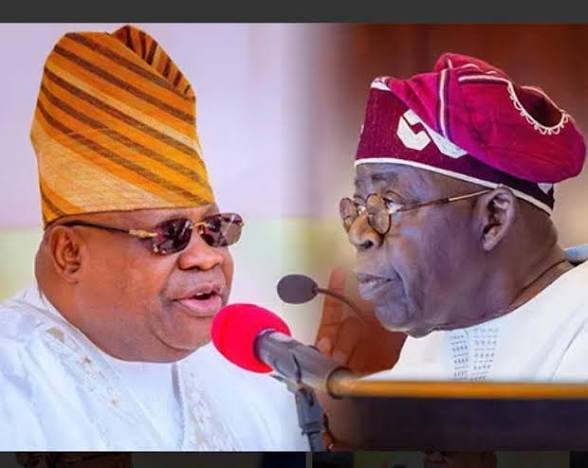
The question now is, what was the presence of Adeleke at the Tinubu’s presidential campaign recently for if not an opposition governor that was acting under influence of coercion? You shut his state account, you withheld his state’s shares of Federal Allocation, you sent your people to burn and tear his campaign posters and billboards but the people rejected to be intimidated and went ahead to elect him.
As if you take the Osun State people for the brainless, you still went ahead with the unleashed social media actors among your government members and supporters to claim that, “If Tinubu wanted APC to defeat Accord in Osun, he would do it, so it was him that made Adeleke win.” Is that so?
There are more instances across the states of the Nigerian Federation where governors are allegedly coerced: “Defect to APC or we dig into the administration of your predecessor or your first tenure and use EFCC to go after you.” Whether that quote as seen in many places is correct would matter not especially when the behaviour of the ruling class confirms same. Same as Delta, same in Akwa Ibom and even now as they are trying to shamelessly implement their naked game of reopening a non-existent corruption case against Atiku Abubakar, the strongest opposition leader in the 2027 race.
Their individual circumstances may differ, but the broader question remains: what happens to the mandate voters gave them when political calculations begin to take precedence over party platforms and campaign promises?
A governor’s defection does not automatically invalidate the people’s mandate. However, when opposition parties are weakened by successive defections, it becomes necessary to examine whether Nigeria’s political environment is encouraging genuine competition or gradually concentrating power in the hands of one party.
Why should the APC seek to dominate the political landscape instead of competing fairly with other parties?
If President Tinubu believes his administration deserves another term, he should present his record, defend his policies and persuade Nigerians through open debate. He should not need a political environment in which opposition parties struggle to survive or elected officials feel compelled to abandon their platforms.
The essence of democracy is not that everyone must belong to the ruling party. It is that citizens must have credible alternatives and the freedom to reject an incumbent government without intimidation or manipulation.
The situation also raises questions about the allegations surrounding the 2023 general election and preparations for 2027. Former Rivers State Governor Nyesom Wike has been associated with controversial remarks about election manipulation. However, any specific allegation that he confessed to rigging the 2023 election or promised to rig the 2027 election must be established from the full context of his verified statements rather than circulated as an unverified quotation.
Nevertheless, the Independent National Electoral Commission (INEC), security agencies and other relevant institutions must demonstrate their commitment to credible elections. Any credible evidence of electoral offences should be investigated, regardless of the political status of those implicated.
President Tinubu must also recognise that the responsibility for protecting democracy rests heavily on the government in power. Nigerians have a right to ask whether the same political system that demands their votes is adequately protecting their freedom to choose opposition candidates.
Calls for accountability, including demands for investigations into alleged abuses of power, should be addressed through constitutional and legal procedures. Impeachment, where constitutionally applicable, and criminal prosecution must follow established legal processes rather than political anger.
Ultimately, Nigeria belongs to its citizens, not to the APC or any other political party. A president seeking re-election must be prepared to compete in a political environment where opposition parties are free to organise, candidates can campaign without intimidation, and voters can make their choices without interference.
President Tinubu cannot demand the people’s mandate for himself while appearing indifferent to their right to choose leaders who do not belong to his party.
That is the democratic question Nigerians must continue to ask as the country approaches the 2027 general election.