US, Israel started this war, only they can stop it for their own sake, says Iran FM Spokesman
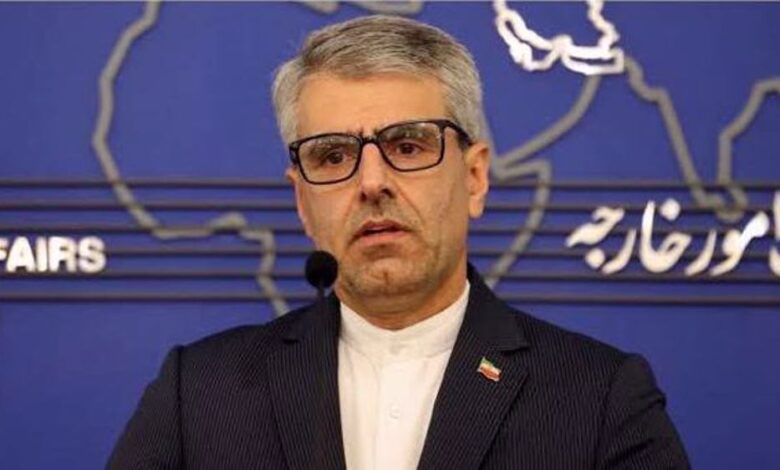
“I think we are not responsible for finding a way out for the aggressors. They started this war of aggression, and we had to defend our homeland,” Baghaei said.
The United States and Israel must take responsibility for the war they started and find their own way out of the quagmire, Iran’s Foreign Ministry spokesman says.


In an interview with Brazilian newspaper Folha de Sao Paulo published on Wednesday, Esmaeil Baghaei said Washington’s justifications for the aggression have been proven baseless.
The aggressors, he said, launched an unprovoked war against Iran on February 28, and the Islamic Republic was forced to defend its homeland.
“I think we are not responsible for finding a way out for the aggressors. They started this war of aggression, and we had to defend our homeland,” Baghaei said.
“I think the American public is gradually realizing that their country was dragged into this war by Benjamin Netanyahu and members of Israel’s war cabinet. They should hold their own government accountable.”
Minab massacre a ‘heinous act’
Baghaei pointed to the attack on the Shajareh Tayyebeh elementary school in Minab, where more than 170 innocent people were killed.
“What they did in Minab, in that elementary school, the killing of over 170 innocent people, is just one example of their heinous behavior against Iran. Why? On what pretext? Their justification for this war has been baseless.”
He said Washington first claimed an imminent threat from Iran, then invoked self-defense, but no armed attack by Iran had occurred.
“There was no animosity between the Iranian nation and the American people. What their government did was a clear act of aggression, arbitrarily carried out at the behest of Israel or others.”
Baghaei urged Washington to act quickly.
“The sooner they decide to get out of this quagmire, the better it will be for their own future and for the entire international community,” he said.
Cooperation with Oman for safe Hormuz transits
On the Strait of Hormuz, Baghaei said Iran, as a coastal state, is working with Oman on a protocol to ensure safe and free passage while respecting Iran’s security concerns.
“We are working with Oman, as the other coastal state, and with relevant international organizations to ensure that our national security is not compromised and that safe passage of ships is guaranteed.”
Iran urges the IAEA to abandon political approaches and stick to its genuine mandate.
He said Iran has more reason than any other country to secure the strait, as it relies on the waterway for its own exports and imports.
Baghaei stated that coastal states are entitled to take measures to prevent the passage of military vessels of aggressors.
“The United States, Israel and their supporters, countries that participated in the crime of aggression, cannot have permission to pass through the Strait of Hormuz because of the impact on Iran’s sovereignty, national interests and national security.”
Ready for any scenario
Asked about the possibility of renewed attacks, Baghaei said Iran must be prepared for any scenario.
“The US continues to violate not only the ceasefire but also the basic principles of international law. The naval blockade alone, according to UN General Assembly Resolution 3314 on the definition of aggression, constitutes an act of aggression,” he said.
“I am sure that our armed forces, in the event of any adventure by the US and Israel, will respond immediately and with full force.”
Baghaei said Iran has learned to defend itself over the past hundred years, recalling the eight-year imposed war in the 1980s when Saddam Hussein was supported by the US, Germany, and others.
“We are strong, determined to defend our homeland, and that is what we have done over the past year and will continue to do.”
The United States and Israel launched their war of aggression against Iran on February 28, assassinating the Leader of the Islamic Revolution and striking nuclear facilities, schools, and hospitals.
Iran responded with 100 waves of decisive, retaliatory strikes under Operation True Promise 4.
A Pakistan‑brokered ceasefire has been in place since early April, but a US naval blockade of Iranian ports remains.
Iran has refused to reopen the Strait of Hormuz until the blockade is lifted and the war permanently ends.