GHOSTED AT 33,000 FEET: America’s $180-million spy drone disappears over Iran
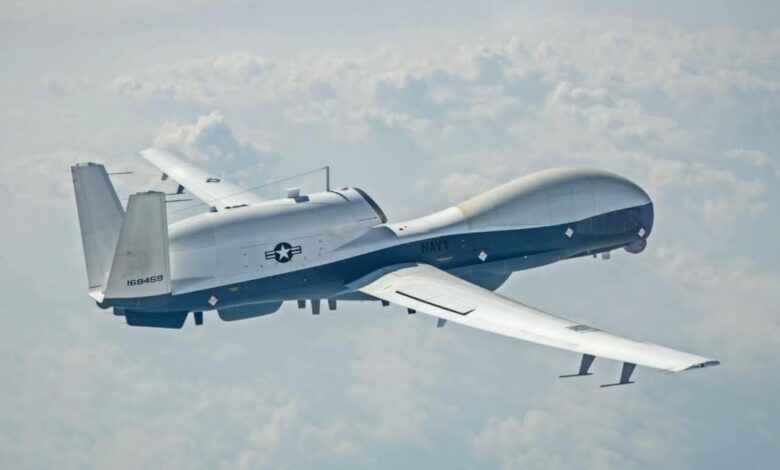
Somewhere over the Persian Gulf, one of the most advanced surveillance machines ever built simply… ceased to exist.
On February 21–22, 2026, a U.S. Navy MQ-4C Triton — a high-altitude, long-endurance reconnaissance drone designed to dominate the skies — transmitted an emergency signal and then disappeared from radar south of Iran. No confirmed debris field. No crash site. No official explanation. Just a blank space where a strategic asset used to be.


For a platform that costs well over $150 million per unit and carries sensors capable of tracking ships, missiles, and electronic emissions across entire regions, vanishing without a trace is not a routine malfunction. It is a strategic event.
And it happened at a moment of rising tension.
Days earlier, U.S. forces had shot down an Iranian Shahed-139 drone approaching the USS Abraham Lincoln — a move Tehran could easily interpret as both provocation and humiliation. In that context, the Triton’s disappearance looks less like an accident and more like a message delivered in silence.
No explosion. No public claim. No escalation ladder climbed in daylight.
Just absence.
Analysts point first to electronic warfare — the invisible battlefield where wars can be fought without gunfire. Advanced jamming systems can sever communication links, spoof GPS signals, or hijack navigation controls, effectively turning a sophisticated drone into a blind, drifting object. If the control link is compromised, operators thousands of miles away can do nothing but watch telemetry collapse.
More sophisticated operations can go further: forcing an aircraft to land intact.
Iran has precedent. In 2011, it captured a U.S. RQ-170 Sentinel stealth drone largely undamaged, later displaying it publicly and reverse-engineering its technology. Tehran claimed it manipulated the drone’s guidance system rather than shooting it down — a claim Western officials never fully refuted.
Then there was 2019, when Iran openly destroyed a U.S. Global Hawk operating in nearly the same region. That incident brought the two countries to the brink of war.
The Triton disappearance sits uncomfortably between those two scenarios: no visible shoot-down, yet no aircraft returned.
Which raises the unsettling possibility that the drone did not crash at all.
If electronic warfare disabled it and Iranian forces recovered the airframe, the intelligence value would be enormous. The MQ-4C carries advanced radar, signals intelligence suites, communication systems, and software architectures representing years of classified development. Even partial access could accelerate countermeasure design or technological imitation.
It would also be a psychological victory — proof that the United States can lose strategic assets without firing a shot.
Some analysts speculate external assistance may have played a role. Russian and Chinese electronic warfare technologies have advanced rapidly, and both nations maintain defense ties with Tehran. Whether through direct support, shared technology, or parallel development, Iran’s EW capabilities today are far more sophisticated than a decade ago.
Yet the most striking detail is not how the drone was lost, but that Washington appears unable — or unwilling — to say what happened.
No confirmation of a shoot-down.
No confirmation of a crash.
No confirmation of recovery.
Just the word “mystery.”
In modern warfare, ambiguity itself is a weapon. If Iran did bring down the Triton intact, public silence denies Washington the option of escalation without hard evidence while allowing Tehran to enjoy quiet deterrence credibility.
The message would be simple: your eyes in the sky are not safe.
Meanwhile, the broader strategic backdrop makes the incident even more volatile. The United States has been building up forces in the region at levels not seen since the Iraq War, while nuclear negotiations with Iran continue under heavy pressure. In that environment, the disappearance of a major reconnaissance platform is not just a technical loss — it is a signal flare in the fog of brinkmanship.
Because surveillance drones are not neutral observers. They are the nervous system of modern military operations. They map targets, track movements, and enable precision strikes. Blind them, and you degrade the enemy’s ability to act.
Whether the Triton now lies at the bottom of the Gulf, in pieces across desert terrain, or inside a hangar being dismantled by engineers, one fact remains:
A machine built to watch everything was itself watched, targeted, and erased.
No dogfight.
No missile plume.
No dramatic footage.
Just a silent disappearance — the kind that makes strategists lose sleep.
In an era where wars are increasingly fought with algorithms, sensors, and electromagnetic pulses instead of bombs alone, the most dangerous victories are the ones no one announces.
Because when a superpower’s eyes go dark, someone else is learning how to see.