Leaked records reveal discrepancies between Tinubu Minister’s NYSC records, NASS documents

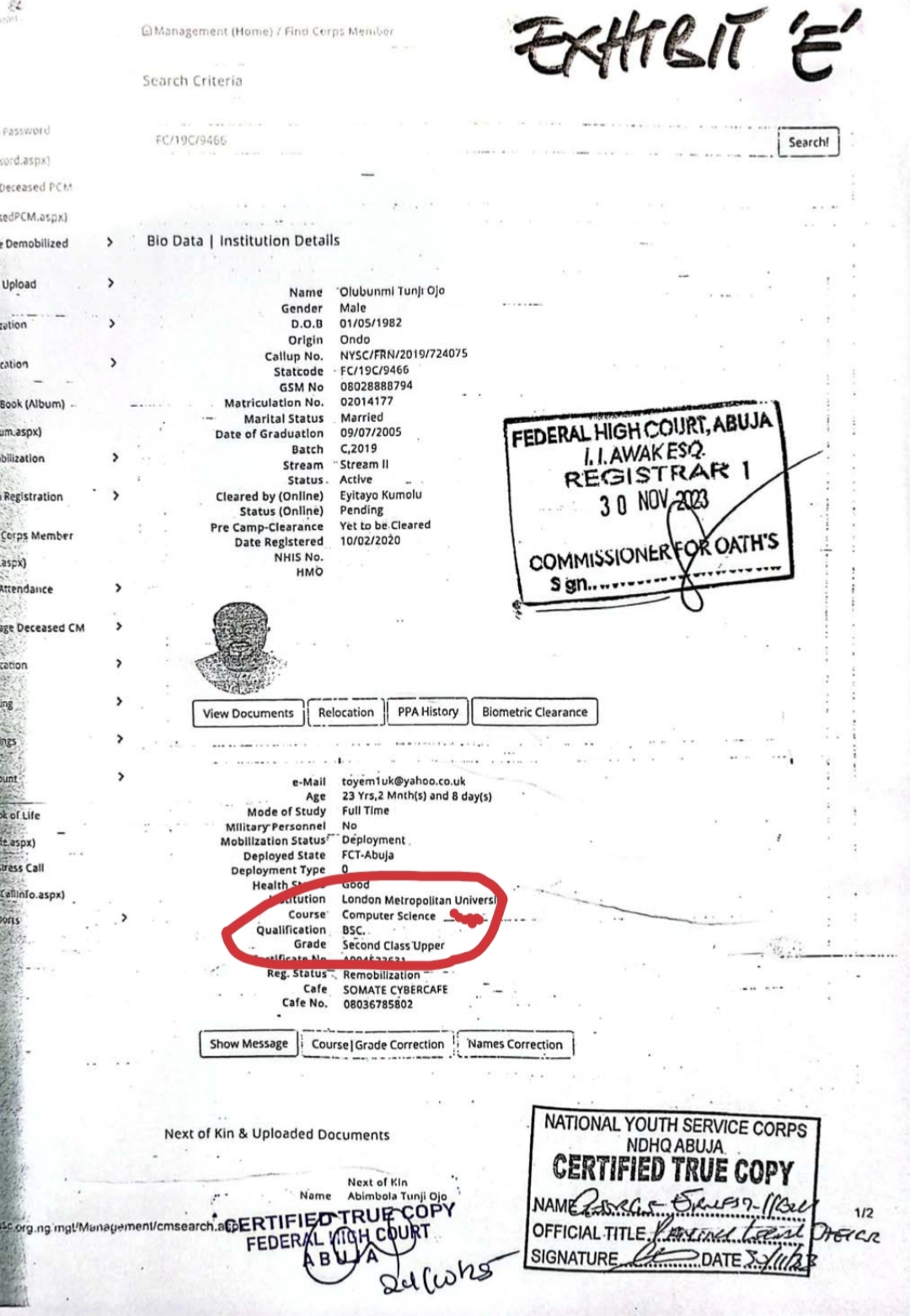
They argue that unresolved discrepancies between the minister’s NYSC records, which reportedly reference a BSc in Computer Science from London Metropolitan University in 2005, and his National Assembly screening documents, which cite a B.Eng in Electronics and Communication Engineering also in 2005 from the same London Metropolitan University, should be urgently clarified in the interest of transparency, national image, and public trust.
A fresh controversy has emerged over the academic credentials of the Minister of Interior, Hon. Olubunmi Tunji-Ojo, following leaked court records that appear to show discrepancies between the qualification used to obtain his National Youth Service Corps (NYSC) certificate and the credentials he presented during his ministerial screening.


The development comes despite earlier assurances by the NYSC that the minister’s documents were in order. New information, however, suggests that the academic details submitted to the NYSC—and later tendered by the scheme before a Federal High Court in Abuja—differ from records independently obtained from London Metropolitan University in the United Kingdom.
According to the leaked court documents, the Director-General of the NYSC, while testifying under oath, stated that Tunji-Ojo was mobilised for national service on the basis of a Bachelor of Science (BSc) degree in Computer Science from London Metropolitan University. This contrasts with the Bachelor of Engineering (B.Eng.) in Electronics and Communication Engineering which the minister reportedly presented to the National Assembly during his screening and confirmation.
The apparent contradiction has renewed calls from civil society organisations and concerned individuals urging President Bola Ahmed Tinubu to direct the minister to step aside pending a comprehensive investigation.
The controversy follows the release of a report by a private investigative firm commissioned to verify the minister’s academic qualifications. The firm concluded that the Bachelor of Engineering degree claimed by Tunji-Ojo from London Metropolitan University could not be authenticated.
According to the investigators, university records show that the minister was admitted into an engineering programme but did not successfully complete his first academic year. The report stated that there is no evidence he repeated the year, advanced to subsequent levels, or graduated from the programme.
“There is no confirmed graduation record, nor any recognised award date for a Bachelor of Engineering degree,” the report noted.
On the minister’s claimed Master’s degree, the investigators argued that admission into a postgraduate programme without a recognised undergraduate degree would be “structurally improbable” under UK academic progression rules. They added that screenshots presented as evidence of a Master’s qualification did not conform to standard institutional formats and could not be independently verified.
The absence of official academic transcripts, the report said, further weakens claims that the minister completed either an undergraduate or postgraduate programme.
In its summary, the investigative firm stated that there is no legitimate graduation date recorded by the awarding institution and no evidence that a Bachelor of Engineering degree was conferred. “Any certificate purporting to represent a B.Eng. degree is not authentic,” the report concluded.
The investigation reportedly reviewed admission records, academic progression data, graduation lists, and the authenticity of certificates and documents submitted by the minister, including a diploma supplement and materials linked to the claimed Master’s degree. Cross-checks against academic archives allegedly revealed inconsistencies in timelines, identification numbers, and award details.
The investigators said they relied on independent academic verification frameworks and secure information channels, some obtained anonymously but described as credible based on past investigations. Media reports and Freedom of Information requests to London Metropolitan University were also reviewed.
As of the time the report was finalised, the university had been formally contacted but had not issued an official response. The investigators stressed that definitive clarification from the institution would be required to conclusively determine whether the degrees were completed.
The revelations have intensified public debate over the legitimacy of the minister’s academic qualifications, particularly his claimed engineering degree. Analysts note that while personal academic claims may be private, presenting such credentials to public institutions like the National Assembly could carry legal implications if found to be false.
Critics warn that prolonged delays in addressing the issue could further erode public confidence in the administration, both within Nigeria and among citizens in the diaspora.
They argue that unresolved discrepancies between the minister’s NYSC records, which reportedly reference a BSc in Computer Science from London Metropolitan University in 2005, and his National Assembly screening documents, which cite a B.Eng in Electronics and Communication Engineering also in 2005 from the same London Metropolitan University, should be urgently clarified in the interest of transparency, national image, and public trust.
See the leaked records below: