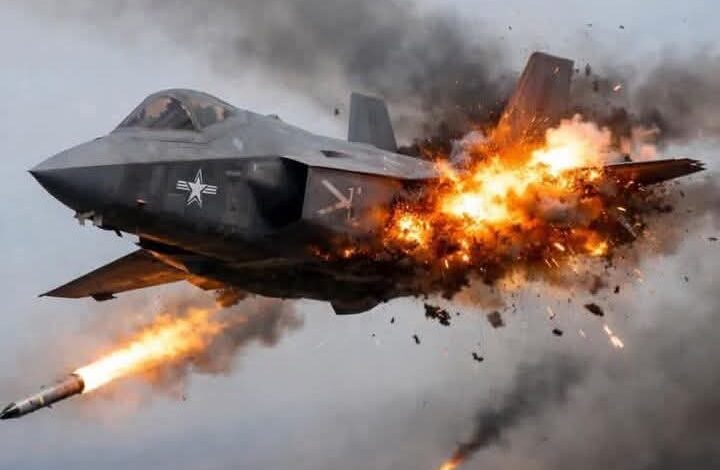
Pentagon confirms damage as Iran demystifies US F-35 jet, makes ‘world’s invisible beast now visible’
*The bit that should really worry the Pentagon – From Akintoye Obisesan’s Diary
The reported strike could signal a shift in modern air defense capabilities, raising questions about the vulnerability of stealth technology in contested airspace.
The United States Central Command,c the Pentagon, has confirmed that one of its advanced F-35 Lightning II aircraft, believed to be world’s best’, sustained significant damage after it was hit by Iranian sir defence missile thus making the claim by America and Israel of their taking over Iran’s air space a fallacy.
Despite the incident, officials stated that the jet was able to return to base, and that the pilot was not injured.
The development comes amid ongoing hostilities involving the United States and its regional ally Israel, with reports indicating that full control over Iranian airspace has not yet been achieved even after nearly three weeks of conflict.
Iran claims precision strike
Iran’s Islamic Revolutionary Guard Corps claimed responsibility for the strike, stating that its air defense systems successfully targeted the stealth jet in central Iran during the early hours of Thursday. According to the IRGC, the operation followed the interception of more than 125 U.S.-Israeli drones and reflects improvements in Iran’s integrated air defense capabilities.
Questions over how stealth jet was hit
The incident is being described as highly unusual, as the F-35 is widely regarded as one of the most advanced stealth aircraft in the world, designed to evade radar detection.
Defense analysts suggest that tracking and targeting such an aircraft would be extremely difficult without external assistance. Some experts speculate that Russia may have provided intelligence or satellite support, though no official confirmation has been made.
Possible weapons used
While Iran has not disclosed the exact weapon used, analysts believe the strike could have involved a loitering munition or a short-range surface-to-air missile, possibly linked to systems like the “358” anti-aircraft platform.
Strategic implications
The reported strike could signal a shift in modern air defense capabilities, raising questions about the vulnerability of stealth technology in contested airspace.
Officials from the United States have not yet released detailed operational data regarding the incident.
From Akintoye Obisesan Diary
The F-35 was supposed to be unkillable. That was the whole point.
Lockheed Martin spent thirty years and four hundred billion dollars, the most expensive weapons programme in human history, building an aircraft that the enemy simply could not see. Not on radar. Not on infrared. Not on anything. The F-35 was not just a fighter jet. It was a theological statement. America’s way of saying: we have moved beyond the reach of your missiles, your sensors, and your prayers.
Iran apparently didn’t get the memo.
Somewhere over Iranian airspace on March 19, 2026, an IRST system, infrared search and track, the kind of sensor your grandmother could probably explain, looked up, found the F-35, and locked on. Not because Iranian engineers are geniuses. Because the F-35, it turns out, is extremely hot. All that engine. All that thrust. All that carefully sculpted stealth geometry, and the bloody thing glows like a kettle.
The heat signature data Iran now holds is not just embarrassing. It is a gift that keeps giving. To Moscow. To Beijing. To every procurement ministry on the planet that has been quietly wondering whether to spend the money on systems designed to kill this aircraft. The answer, as of this week, is yes.
And here is the bit that should really worry the Pentagon. You can patch software. You can redesign coatings. You cannot reprogramme a pilot’s brain. Every F-35 driver who takes off from here on knows, actually knows, that someone down there might be able to see them. That changes everything about how they fly. Caution replaces aggression. Hesitation replaces instinct.
Four hundred billion dollars. And in the end, it was done in by a heat sensor.
Tremendous.
Gandalv / @Microinteracti1