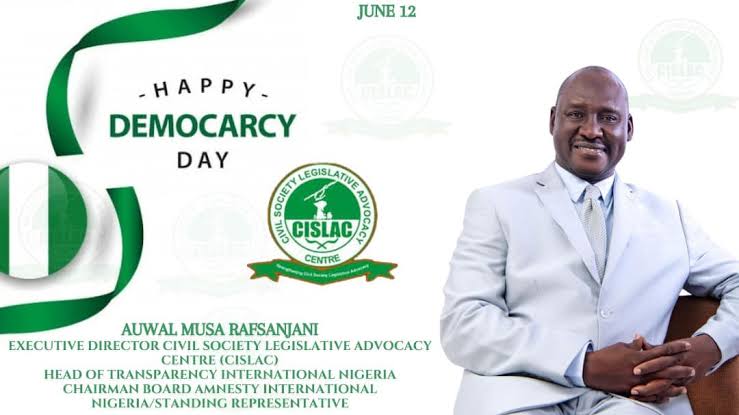
CISLAC marks June 12, honours fallen heroes, raises concerns over state of democracy
By KEMI KASUMU
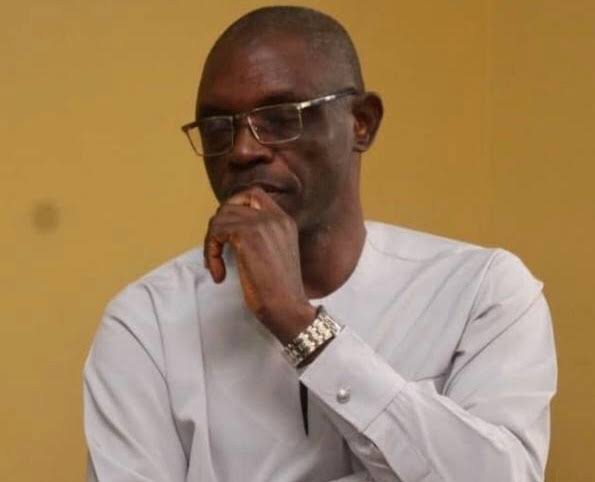
“Democracy must go beyond mere survival,” the statement signed by CISLAC Executive Director, Comrade Auwal Musa Rafsanjani, said. “It must deliver dignity, safety, and prosperity for all Nigerians.”
The Civil Society Legislative Advocacy Centre (CISLAC) has commemorated June 12, describing it as a defining moment in Nigeria’s democratic journey and a reminder that democracy was earned through sacrifice rather than granted.
In a statement issued to mark Democracy Day, CISLAC said June 12 symbolises the courage, resilience, and determination of Nigerians who confronted authoritarian rule in pursuit of justice, accountability, human rights, and popular sovereignty.
The organisation paid tribute to numerous pro-democracy activists and patriots whose efforts shaped Nigeria’s democratic evolution. Among those honoured were Chief MKO Abiola, Hajia Kudirat Abiola, General Shehu Musa Yar’Adua, Balarabe Musa, Chief Gani Fawehinmi, Ken Saro-Wiwa, Prof. Eskor Toyo, Prof. Festus Iyayi, Comrade Chima Ubani, Barrister Bamidele Aturu, Comrade Emma Ezeazu, Dr. Yima Sen, Mallam Abubakar Sokoto, Professor Abubakar Momoh, Dr. Bala Jibrin, Joseph Mamman, Anslem Akele, Abdulrahman Black, Oby Nwankwo, Comrade Hassana Garba, Comrade Abiodun Aremu, Mr. Alao Aka-Bashorun, Innocent Chukwuma, Bagauda Kalthoum, Dr. Bala Yusuf Usman, Dr. Segun Osoba, Barrister Chris Abashi, Nelson Ananze, Bar. Hauwa Evelyn Shekarau, Comrade Christy Adambara, Farida Mustapha, Alhaja Raliat Daniju, Douglas Oronto, Hajiya Bilikisu Yusuf, Dr. Ola Oni, Mrs. Kehinde Ola Oni, Cosmos Attayi-Elaigu, Bene Madunagu, Dr. Tajudeen Abdulraheem, Comrade Ali Ciroma, Dr. Peter Ozo-Eson, Comrade Olaitan Oyerinde, Comrade Abiodun Ogunade (Revo), Comrade Basil Chianson, and Bello Aidoloje.
CISLAC also recognised the authors of the Minority Report of the 1978 Constitutional Conference and other unsung patriots whose contributions laid the foundation for Nigeria’s democratic governance.
Concerns Over Security and Governance
While acknowledging 26 years of uninterrupted civilian rule and peaceful political transitions, the organisation stressed that democracy must be measured not only by regular elections but also by its capacity to guarantee security, welfare, justice, and inclusive development.
CISLAC expressed concern over worsening insecurity across the country, citing terrorism, banditry, kidnapping, communal clashes, and farmer-herder conflicts. It warned that democracy cannot flourish amid widespread fear and called for comprehensive security reforms focused on intelligence gathering, accountability, and prevention.
Economic Hardship and Youth Unemployment
The group also highlighted growing economic challenges, including inflation, unemployment, and rising living costs, noting that recent policy reforms such as fuel subsidy removal and exchange rate adjustments have intensified hardship for many Nigerians.
While recognising the intent behind the reforms, CISLAC urged the government to implement inclusive, people-centred policies that prioritise social protection and reduce inequality.
It further warned that high levels of youth unemployment and underemployment pose a threat to national stability, contributing to irregular migration, social unrest, and insecurity. The organisation called for increased investment in education, skills development, entrepreneurship, agriculture, and industrialisation to harness the potential of Nigeria’s youthful population.
Corruption, Electoral Integrity, and Public Institutions
CISLAC identified corruption as a major impediment to democratic and developmental progress, stating that it continues to erode public trust and divert resources from essential sectors such as health, education, and infrastructure. It advocated stronger institutions, whistleblower protection, transparent procurement processes, and impartial enforcement of accountability measures.
On electoral reform, the organisation acknowledged improvements in recent elections but expressed concern over vote buying, electoral violence, low voter turnout, and the influence of money in politics. It also criticised weak internal party democracy, including candidate imposition and manipulated primaries, urging reforms to strengthen political parties as democratic institutions.
Education, Healthcare, and Civic Space
The group raised alarm over challenges in the education and healthcare sectors, including the high number of out-of-school children, inadequate infrastructure, staff shortages, and rising service costs. It emphasised that sustainable democracy depends on strong investment in human capital development.
CISLAC also expressed concern over shrinking civic space, declining public trust in institutions, and perceived threats to judicial independence and the rule of law. It called for independent institutions capable of operating without political interference.
Call to Deepen Democracy
Concluding its Democracy Day message, CISLAC stated that sustaining democratic rule for 26 years is significant but insufficient if it does not translate into improved livelihoods, security, justice, and accountable governance.
The organisation urged government officials, political actors, civil society groups, the media, and citizens to recommit to transparency, accountability, participation, and democratic principles.
“Democracy must go beyond mere survival,” the statement signed by CISLAC Executive Director, Comrade Auwal Musa Rafsanjani, said. “It must deliver dignity, safety, and prosperity for all Nigerians.”