After blaming Buhari, Tinubu finally admits fuel subsidy removal, vows: “I have no regrets; We cannot go back to Egypt”
By KEMI KASUMU and OUR REPORTERS
Buhari had explicitly rejected suggestions by the World Bank and the International Monetary Fund (IMF) that Nigeria remove the fuel subsidy and devalue the naira, saying Nigerians were already suffering and that he did not want to add to their hardship.
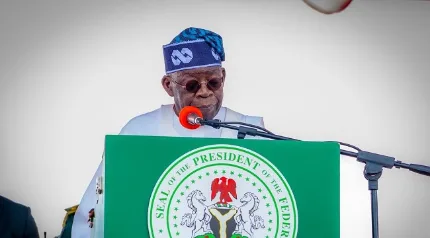
The DEFENDER reports that after blaming his predecessor, Muhammadu Buhari, for the fuel subsidy removal he claimed was responsible for the untold hardship and unprecedented poverty Nigerians had experienced since he assumed office on May 29, 2023, President Bola Ahmed Tinubu on Monday, October 19, 2026, declared that he had no regrets about removing the petrol subsidy, insisting that Nigeria could not return to what he described as “Egypt.”
The President spoke at a forum titled “Together Till 2027: An Evening with Original City Boy,” organised by the City Boy Movement in conjunction with the “Relax, Tinubu Is Fixing Nigeria” movement at the Old Banquet Hall of the Presidential Villa, Abuja.
The Blame Game
Tinubu, who also commended his son, Seyi Tinubu, patron of the City Boy Movement, a political support group campaigning for his re-election, had, alongside his government aides and supporters, previously told Nigerians that they were experiencing untold hardship because former President Muhammadu Buhari had removed the fuel subsidy before handing over a bankrupt national economy to him in 2023.
To justify the claims, his supporters, both in and outside government, cited the non-inclusion of fuel subsidy in the 2023 budget he inherited. However, media rejoinders quickly pointed out that Buhari’s decision not to include fuel subsidy in the 2023 budget did not mean he had removed it.
Rather, Buhari had pursued what critics of Tinubu’s policy described as a more pro-people and patriotic alternative to tackling subsidy-related corruption, under which Nigerians continued to buy petrol at between ₦184 and ₦185 per litre, depending on the part of the country.
The former president rather centred importation of fuel on the Nigerian National Petroleum Corporation Limited (NNPCL), asking it to import, pay all subsidy related costs on its imports and sell directly to Nigerian consumers through its own NNPCL outlets and major marketers while leaving out allegedly corruptive independent marketers sabotaging the fuel subsidy to source for own foreign exchange and import their own fuel and sell to Nigerians.
Buhari had explicitly rejected suggestions by the World Bank and the International Monetary Fund (IMF) that Nigeria remove the fuel subsidy and devalue the naira, saying Nigerians were already suffering and that he did not want to add to their hardship.
Instead, Buhari considered alternative measures and prioritised support for the then ongoing Dangote Refinery project, which had Federal Government investment. He supported the project through to completion and commissioned the refinery in Lagos before leaving office on May 29, 2023.
Buhari’s vision for the Dangote Refinery was to encourage private-sector participation in domestic crude oil refining while also pursuing the comprehensive rehabilitation of the Port Harcourt Refinery with a $1.5 billion foreign loan. The aim was to reduce Nigerians’ exposure to the disruptions and price fluctuations associated with imported petroleum products.
After Buhari left office, Tinubu’s approach to supporting domestic refining differed from that of his predecessor, amid continuing disagreements and controversies surrounding the supply of crude oil to the Dangote Refinery. The refinery subsequently relied substantially on crude oil imports from abroad.
Tinubu’s supporters offered different explanations for why his administration would not provide the level of support Dangote sought. Some alleged that Alhaji Aliko Dangote had not supported Tinubu’s presidential ambition.
The dispute over the Dangote Refinery continued until its chairman went before the international press to raise concerns about what he described as efforts to undermine him and his business, despite the refinery’s capacity to produce petroleum products locally.
Dangote also challenged Tinubu’s claim that the refinery’s land in Lekki, Lagos, had been provided to him free of charge to attract investment to the state. He maintained that he had paid $100 million to acquire the land and had not received it for free.
De Renaissance Patriots Foundation, the socio-cultural organisation representing Lagos State indigenes, subsequently went public to demand clarification on whom the $100 million was paid to and how the money was utilised. However, no satisfactory response has emerged from the Lagos State Government on the demand, while the issue remains unresolved in the public discourse.
The Admission
As his administration approaches its fourth year, Tinubu has now emphatically defended the fuel subsidy removal as his own policy decision, declaring that he has no regrets and that Nigeria cannot return to what he described as “Egypt.”
Addressing the gathering, Tinubu said the support of young Nigerians had strengthened his resolve to continue with his administration’s policies.
“When I walked into this hall, I did not see a crowd. I saw Nigeria. I saw why I ran for the presidency of this country. I saw why I wake up every morning to work. I saw the reason. Now, I have no regret. I saw the future that belongs to you,” he said.
The President thanked his supporters for standing by his administration despite the economic difficulties Nigerians had experienced over the past three years.
“The road we have walked these past three years has not been easy. We took hard decisions that you heard from Kashim Shettima,” he said.
Defending the removal of the petrol subsidy, Tinubu said he could not support calls by opposition politicians for its reinstatement.
He drew a biblical and Qur’anic parallel with the story of Moses and the Israelites’ departure from Egypt, arguing that Nigeria should not reverse the economic reforms introduced by his administration.
“I could listen to my political opponents promising a return to subsidy. Most of all, sometimes I remember my scripture studies, both in the Bible and the Holy Quran. When Moses left Egypt, they faced a challenge, and the Red Sea parted and gave way.
“You cannot ask Moses to go back to Egypt. We wake up with ideas, original thoughts and deep thinking to move this country forward. With your energy and support, we will never go back to Egypt.
“No regrets,” the President declared.
Tinubu maintained that the Nigerian economy was moving in the right direction, citing reports of economic growth in China and describing Nigeria’s economic outlook as promising.
“We are on the right trajectory. We are in good company. The economy is growing steadily. You will have a future, a future to believe in,” he said.
He urged young Nigerians to see their support for his administration as an investment in their own future, adding that Nigeria’s success in the 2027 election should take precedence over the personal ambitions of any candidate.
“Nigeria must win this election before any candidate does. You are not campaigning for me. You are campaigning for your own future, and that future is Renewed Hope. There is nothing that will push us back,” he said.
The President also recalled the economic challenges his administration inherited, including difficulties in meeting financial obligations, concerns over foreign reserves and the country’s ability to meet its commitments to international airlines.
He said his administration had learnt from the shortcomings of previous governments and undertaken reforms to strengthen the tax system and reposition the economy.
Tinubu also reiterated his commitment to ending prolonged university strikes, saying he had promised that students should be able to complete four-year degree programmes within four years.
According to him, the administration’s economic policies required patience and understanding from Nigerians, particularly young people who had continued to defend the government despite criticism.
He praised the City Boy Movement for establishing what he described as an organised political structure, with members across states, local governments, wards and polling units.
The President said the movement’s call centre and City Boy Care initiative had also helped it engage young Nigerians and respond to the needs of their communities.
“That is not noise. That is organisation. That is excellent thinking. That is the kind of seriousness this country needs from its young people, and I am very proud of you,” he said.
Tinubu also thanked youth support groups in Nigeria and abroad, acknowledging their efforts to promote his administration’s policies.
He assured young Nigerians that they would have a place in the country’s future, declaring that the next generation, rather than the current political leadership, would ultimately determine Nigeria’s direction.
“The future of this country does not belong to me, and it does not belong to my generation. It belongs to you,” he said.
The President further defended the Student Loan Act, saying he had no regrets about signing it and that more than one million students had received support through the Nigerian Education Loan Fund (NELFUND).
Tinubu Advises Son, Seyi
Tinubu commended his son, Seyi, for his involvement in mobilising young Nigerians through the City Boy Movement.
He said Seyi had devoted his time to engaging young people, listening to their concerns and organising them without seeking a political title or public office.
“I am proud of all of you. But I will tell you what every father tells a son: you have only started. Do more, not less. Serve harder. Set an example that your own children, my grandchildren, will be proud to follow,” he said.
The President urged young Nigerians to ensure that eligible voters obtained their Permanent Voter Cards (PVCs) and participated in the electoral process.
He also encouraged them to campaign by explaining the policies and achievements of his administration.
Tinubu maintained that the removal of the petrol subsidy had been necessary, arguing that the government could no longer sustain the cost of the programme.
Shettima Says Economy Would Have Collapsed Without Reforms
Vice President Kashim Shettima said the Nigerian economy could have collapsed if Tinubu had failed to take what he described as far-reaching economic decisions.
According to Shettima, the administration’s reforms had helped reposition the economy and improve key economic indicators.
He cited economic growth of 4.43 per cent in the preceding quarter and said Nigeria’s foreign reserves were hovering around $60 billion.
“The President took those far-reaching decisions. He had the courage of conviction and the knowledge to take those far-reaching decisions that repositioned the Nigerian economy, so that now the economy grew by 4.43 per cent in the last quarter.
“Most importantly, our foreign reserves are now hovering around the level of $60 billion,” he said.
Shettima argued that critics who opposed the reforms would have been confronting a much worse economic situation if the government had failed to act.
He acknowledged that Nigerians had experienced hardship but insisted that the consequences could have been more severe without the government’s intervention.
“The President has to be commended, not demonised. Yes, Nigerians have gone through some tough times, but it could have been worse,” he said.
The Vice President also expressed optimism that food prices would decline, promising that the President would introduce further measures to address challenges in the agricultural sector.
“Be reassured that in the coming weeks, the President will come up with robust responses to agricultural challenges, and the prices of foodstuffs will certainly come down,” he stated.
Shettima further highlighted government initiatives in education financing and infrastructure development, urging young Nigerians to communicate the administration’s policies to the public.
“I urge the youth of Nigeria. I beseech thee. I implore you to go out to the streets and tell the truth to other Nigerians,” he said.
City Boy Movement Declares Support for Tinubu
In his remarks, the Director-General of the City Boy Movement, Hon. Francis Shoga, declared the group’s readiness to mobilise young Nigerians in support of the administration’s agenda.
Shoga said the movement was committed to promoting national unity, patriotism, responsible civic participation and economic development.
“Mr President, we stand before you with a clear, powerful and unshakable message: the youths of Nigeria are ready. We are ready to work. We are ready to serve, and we are ready to take purposeful action for the progress, unity and prosperity of our great nation,” he said.
He described the movement’s members as committed supporters of Tinubu’s administration and said they would continue to promote the President’s Renewed Hope agenda.
According to Shoga, the movement aims to inform and empower young Nigerians, helping them understand government policies, identify available opportunities and participate in national development.
“Our mission is to inform, engage, inspire and empower Nigerian youths so that they understand the direction of government, recognise available opportunities and participate confidently and responsibly in national development,” he said.