Tinubu Asks US Court to Block Release of His FBI, DEA Records in Long-Running FOIA Case

By OUR REPORTER
Von Batten-Montague-York said Tinubu’s latest position effectively places his privacy rights at the centre of the dispute, despite public interest in records concerning the background and fitness of a sitting Nigerian president.
President Bola Ahmed Tinubu has asked a United States federal court to block the public release of records held by the US Department of Justice (DOJ), Federal Bureau of Investigation (FBI) and Drug Enforcement Administration (DEA) in a long-running Freedom of Information Act (FOIA) case concerning him.

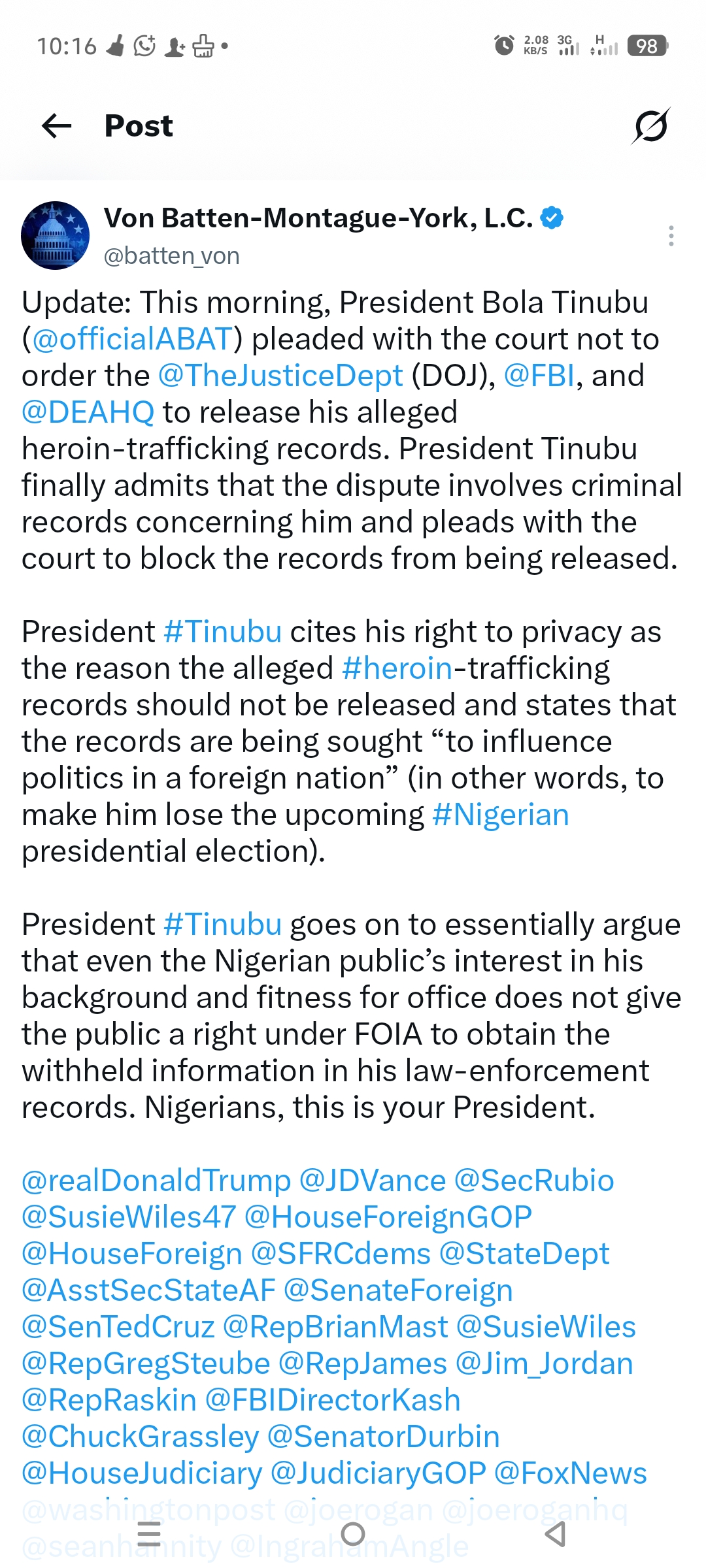
The latest development was disclosed on Saturday, August 29, 2026, by Washington-based lobbying firm Von Batten-Montague-York, L.C., in an update posted on X.
The development was also confirmed by Tinubu’s lawyers according to a local media platform on Saturday August 29.
The records are being sought by American transparency activist Aaron Greenspan, who filed a Freedom of Information Act (FOIA) lawsuit against several US government agencies seeking documents relating to investigations involving Tinubu.
Greenspan’s requests include the FBI’s entire file on Tinubu and FBI Form 302 interview records concerning the period between 1992 and 1993.
The $460,000 link
The case also involves an alleged record connected to a 1993 civil forfeiture proceeding in the United States involving about $460,000 linked to Tinubu but the president has denied wrongdoing in the matter.
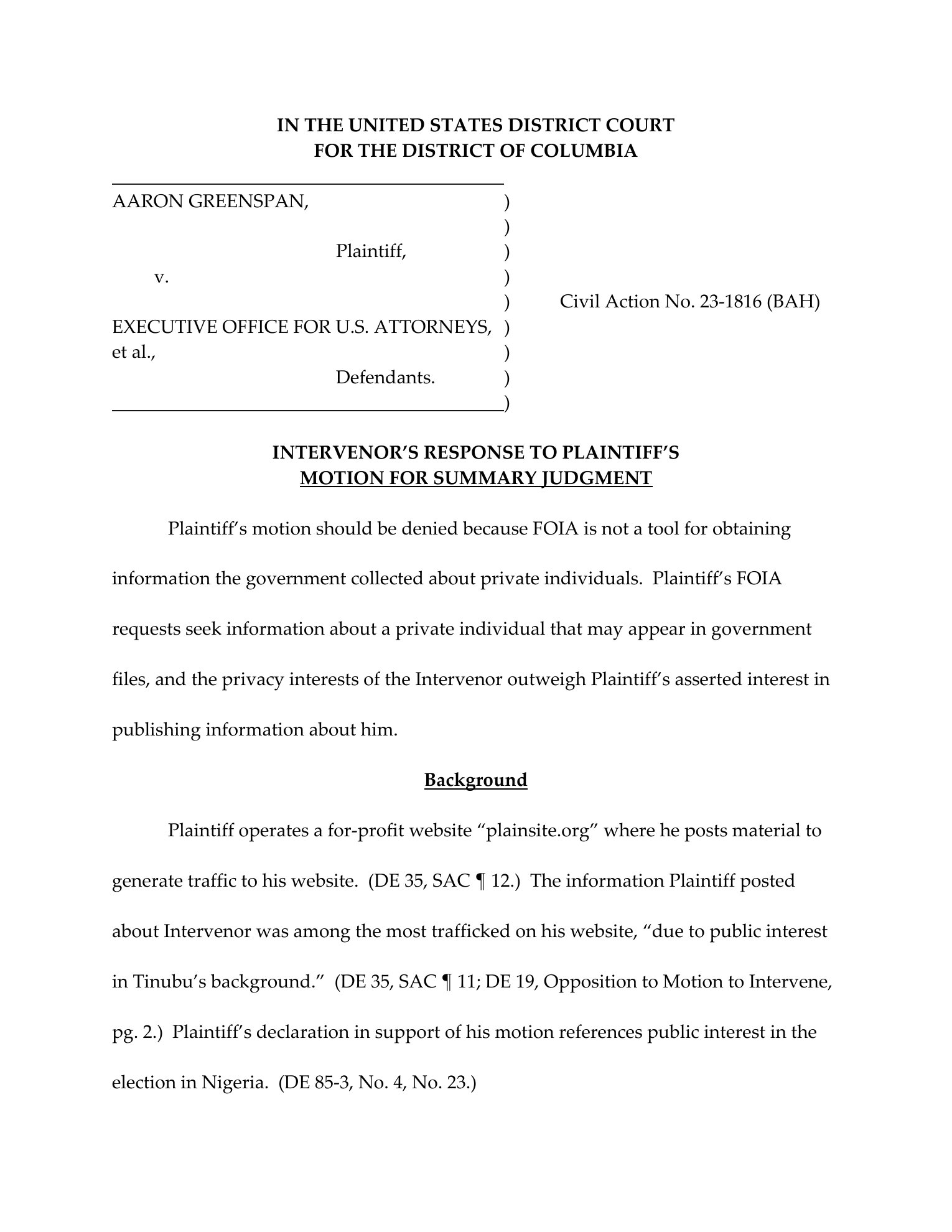
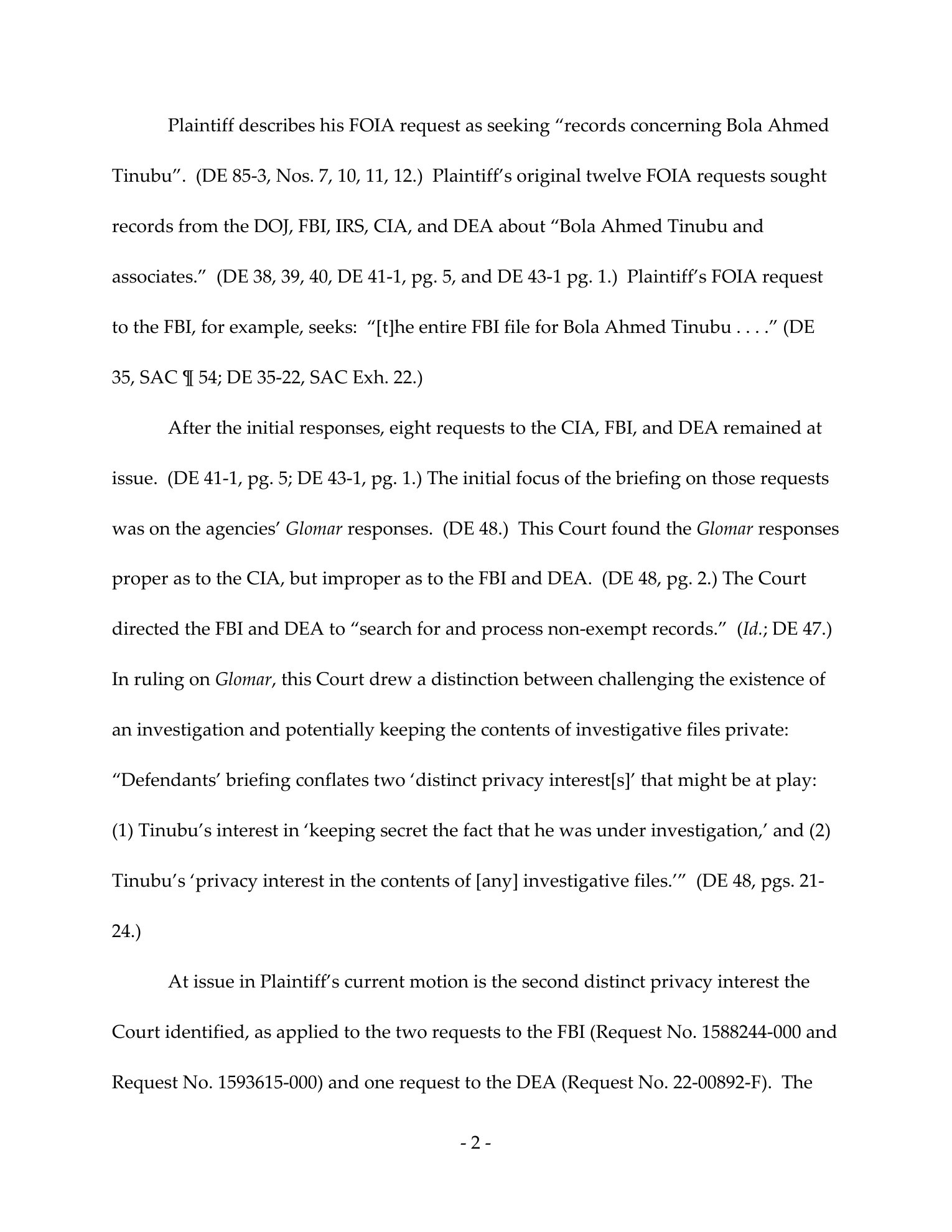
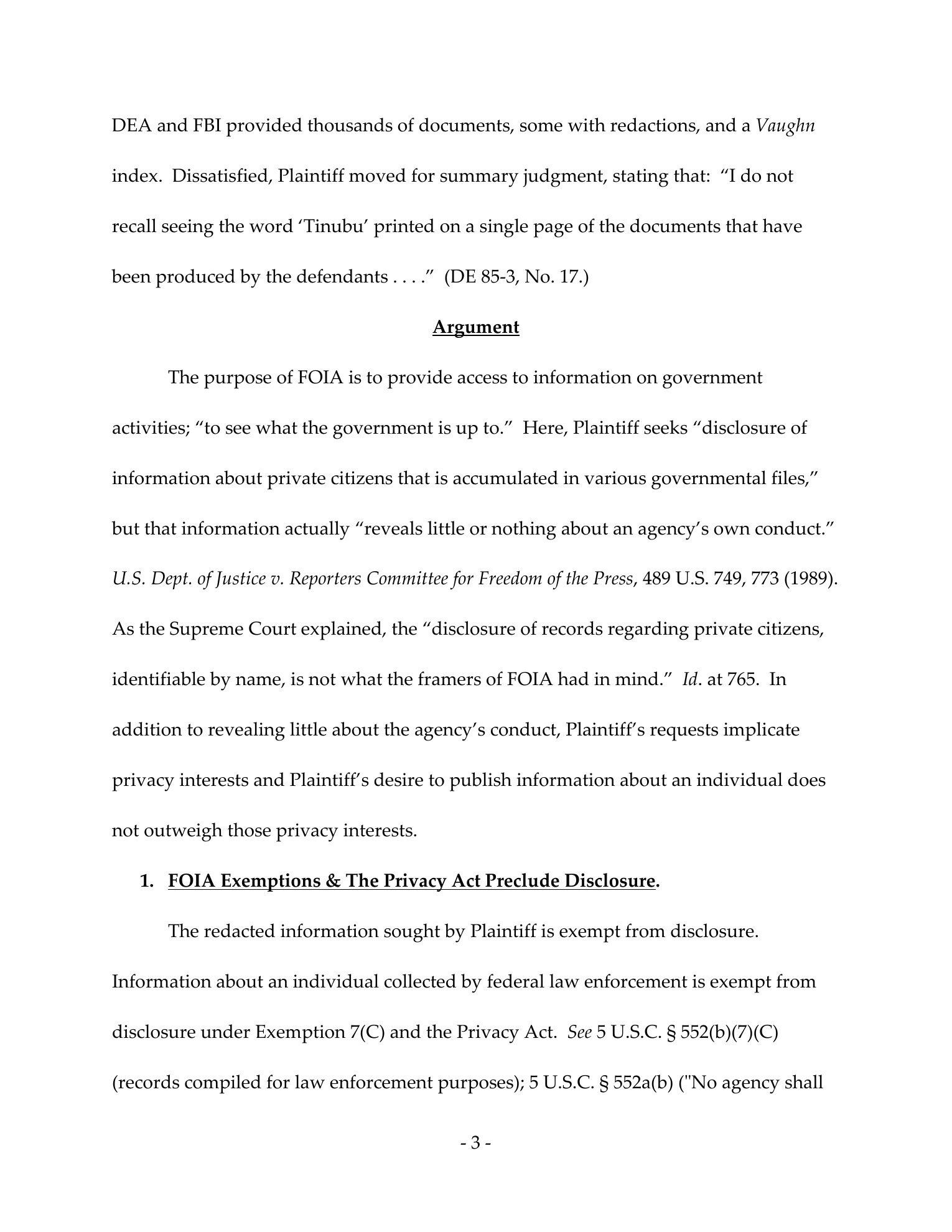
According to the 16-page court documents reportedly shared by his lawyer and legal team, Christopher W. Carmichael, Victor P. Henderson, and Oluwole O. Afolabi, on Saturday, Tinubu argued that the release of the records could infringe on his privacy.
“Submitted in that proceeding, did not reveal the details of a possible criminal investigation (or its results) involving Intervenor. Other than by speculation or labels, Plaintiff does not point to an existing public record that contains details of a governmental criminal investigation or findings about Intervenor. (DE 85-3, No. 16.)
“The purpose of Plaintiff’s motion is to obtain such information because it is not public. Moreover, Plaintiff’s argument that the limited disclosures in connection with the forfeiture negates all privacy interests is not consistent with precedent. The Supreme Court explained that an individual retains a privacy interest in an entire file or document being produced, even where there are “scattered” disclosures of information from that same file. See Reporters Committee, 489 U.S. at 764-67 (“our cases have recognized the privacy interests inherent in the non-disclosure of certain information even where the information may have been public at one time.”).
“While some information may appear in portions of public records, an individual still retains a privacy interest in the details that remain undisclosed. Applying Reporter’s Committee, this Court explained that an individual retains a privacy interest even if they were previously publicly associated with criminal activity. Judicial Watch, Inc. v. United States Dept. of Justice, 898 F.Supp.2d 93, 104-05 (D.D.C. 2012).
“Other decisions have likewise described the fact someone was under investigation as “distinct” from the contents of the investigative files. See Electronic Privacy Info. Center v. United States Dept. of Justice, 18 F.4d 712, 719 (D.C. Cir. 2021) (“Although the names of – 6 – Case 1:23-cv-01816-BAH Document 98 Filed 08/28/26 Page 7 of 16 Trump campaign officials appear in public portions of the Report, they retain a privacy interest in ‘avoiding disclosure of the details of the investigation.’”)
“Regardless of the prior disclosure in the forfeiture proceeding, Intervenor retains a privacy interest in potential disclosure of the investigative files sought by Plaintiff”, the document read in part, according to the local media report.
Von Batten-Montague-York L.C.
According to the Washington-based lobbying firm Von Batten-Montague-York, L.C., Tinubu’s latest court filing argues that the records should remain withheld on privacy grounds and contends that the request for their disclosure is connected to efforts to influence politics in Nigeria ahead of the 2027 presidential election.
The firm quoted Tinubu’s position as arguing that the records were being sought “to influence politics in a foreign nation.”
Von Batten-Montague-York interpreted the reference as an indication that the disclosure campaign was intended to affect Tinubu’s political prospects in the forthcoming Nigerian presidential election.
The development comes amid a protracted FOIA litigation over US law-enforcement records relating to historical investigations involving Tinubu. The case was brought by American transparency activist Aaron Greenspan, who has sought records from several US government agencies.
US District Judge Beryl Howell has been overseeing the case in the United States District Court for the District of Columbia.
Earlier this month, the FBI asked the court for permission to provide part of its justification for withholding certain records privately through an ex parte, in-camera submission. Such a filing allows sensitive information to be presented directly to the judge without being made public.
The court subsequently permitted the FBI to submit sensitive material privately and directed the FBI, DEA, DOJ and Tinubu’s legal team to make their final submissions by August 28, 2026.
The dispute centres on records sought under FOIA concerning historical US investigations linked to allegations of narcotics trafficking. Tinubu has not been criminally convicted of heroin or drug trafficking in the United States. The matter has also been associated with a 1990s civil forfeiture involving about $460,000 that was forfeited to the US government.
The latest update, however, has intensified political debate in Nigeria, particularly because former Vice-President Atiku Abubakar is seeking to challenge Tinubu politically ahead of the 2027 election and the Washington-based firm reporting the development has been retained by Atiku.
Von Batten-Montague-York said Tinubu’s latest position effectively places his privacy rights at the centre of the dispute, despite public interest in records concerning the background and fitness of a sitting Nigerian president.
The firm also argued that the Nigerian public’s interest in the records should be considered in determining whether the information ought to remain protected under FOIA.
The case remains before the US court, and the latest filing does not by itself establish that Tinubu committed heroin trafficking or any other criminal offence. The central legal question is whether the records sought under FOIA are subject to disclosure or fall within exemptions that allow US law-enforcement agencies to withhold them.
The court’s eventual decision on the competing claims could have significant political implications in Nigeria as the country moves closer to the 2027 presidential election.
See screenshots from Von’s X handle below: