China Rejects US Call to Support Economic Sanctions on Iran
Beijing says sanctions on Iran would only inflame tensions in the Middle East. Meanwhile, China has cut US Treasuries to an 18-year low, while moves to liquidate China Evergrande gain momentum.
Chinese officials rejected a call by US leaders to back an economic war against Iran, saying on Thursday it opposes any illegal and unilateral sanctions that aren’t authorized by the UN Security Council or international law.

US Treasury Secretary Scott Bessent had called on Beijing to “get with the program” and back an economic campaign aimed at getting the Iranian regime to comply with the White House’s demands to end the war.
But Chinese Foreign Ministry said “sanctions and pressure will not help resolve the issue” and would only heighten regional tensions. It urged Washington and other parties to pursue a resolution through political and diplomatic dialogue rather than economic coercion.
US President Donald Trump, who has been under pressure at home over the impact of the war and with crucial midterm elections looming, vowed this week to isolate the Iranian economy and bring the Iranian regime to the point of collapse.
Trump’s pledge on Wednesday of unprecedented “economic warfare” on Iran comes as the president grows increasingly frustrated with the lack of movement on the military front.
In a post on his Truth Social platform, the US leader said he was announcing “the MOST CRUSHING ECONOMIC OPERATION EVER TAKEN AGAINST ANY COUNTRY! This will be Economic Warfare and Isolation on an unprecedented scale.”
‘Economic terrorism’
But Iran said the US threats were “economic terrorism” and they would fail.
“The so-called ‘Economic D-Day’ is a diversion from America’s own crisis: unprecedented debt & surging interest costs,” Iran’s Foreign Minister Abbas Araghchi said in a post on X.
Despite the heavy international sanctions and a US-enforced naval blockade in the Gulf, Iran has found ways to continue exporting its oil, with China as its biggest buyer. Tehran operates a so-called shadow fleet of tankers, all of which are under international sanctions.
Bessent echoed President Trump’s comments, doubling down on economic pressure on Tehran as Trump’s unpopular war drags toward the six-month mark.
“Any remaining tie to Tehran will hasten a nation’s economic oblivion, whether that tie be purposefully constructed or willfully ignored,” Bessent said on X.
Washington announced new measures on Thursday against Hezbollah’s financing network in Lebanon, highlighting its close ties with Iran’s Revolutionary Guards.
Chinese firms told to ignore US call
Meanwhile, China’s Commerce Ministry told domestic companies and independent “teapot” oil refineries to ignore the US sanctions.
Beijing reportedly invoked a 2021 blocking statute that reportedly prohibits Chinese firms from complying with foreign sanctions deemed illegitimate.
The diplomatic standoff occurs at a delicate time, given US officials are trying to finalize an agenda for Chinese President Xi Jinping, who is expected to visit Washington in the last week of September.
‘Time to end war’
Iran’s Islamic Revolution Guard Corps (IRGC) said the country would use more “devastating” weapons if a new conflict starts.
IRGC spokesperson Hossein Mohebbi said in an interview with Iran’s Defa Press news agency, that was published on Thursday and reprinted by Xinhua in China.
“If another war begins, our weapons will definitely be different … in terms of the generation of missiles’ warheads, as well as their precision and range,” Mohebbi said.
Iran’s production of armaments had not stopped, he said, adding: “The destruction power of the warheads used in the IRGC’s (new) missiles is far greater than the models used in the previous wars.”
But later on Friday, Iranian President Masoud Pezeshkian said it was time to end the months-long Middle East war with the United States. Why? Because Tehran was in a position of strength over Washington, he said.
“It is better that we bring the war to an end now as we are in a position of power and dignity, and the whole world acknowledges our victory and emphasises that America has attacked our schools, hospitals and infrastructure in violation of all regulations and is hated around the world,” he said in a meeting with doctors, according to Agence France-Presse.
China cuts US Treasuries to 18-year low
Meanwhile, China has reduced its holding of US Treasuries to $633.4 billion, its lowest level in 18 years, according to a report in Hong Kong.
Beijing is diversifying its foreign exchange reserves “amid geopolitical tensions and uncertainty over the US policy outlook,” the South China Morning Post said earlier this week, noting that this was the lowest level since September 2008.
In other China news, a court in Guangdong formally accepted a bankruptcy liquidation petition against the main onshore unit of China Evergrande, the construction giant that collapsed in 2021 with debts allegedly exceeding $300 billion.
“The Guangzhou Intermediate People’s Court said on Friday that Guangzhou Rural Commercial Bank’s Huaxia branch met the legal criteria under the nation’s Enterprise Bankruptcy Law to force the Evergrande unit, Hengda Real Estate, into liquidation, citing the firm’s inability to pay mature debts and insufficient total assets,” the South China Morning Post reported separately on Friday.
The decision followed a ruling on Thursday by the Shenzhen Intermediate People’s Court, which handed a life sentence to Hui Ka Yan, Evergrande’s billionaire founder, after a high-profile trial over financial fraud and mismanagement.
Turmoil in debt markets
Global stock markets traded cautiously on Friday as investors assessed the US Treasury’s effort to push down long-term borrowing costs, which spiked this week.
Oil prices held onto the week’s gains as the United States and Iran remained deadlocked over a deal to reopen the Strait of Hormuz.
Bitcoin rallied and the dollar fell as the initial boost from the US Treasury’s surprise move to buy back more of its own bonds faded at the end of the week.
“The turmoil in the debt markets continues despite efforts to calm feverish borrowing costs,” Susannah Streeter, chief investment strategist at Wealth Club, was quoted as saying by AFP.
“Investors remain concerned about inflationary risks and the growing mountain of government borrowing, while at the same time, debt being issued by tech giants building out the AI revolution is offering stiff competition,” she added.
The US Treasury’s action came after the 30-year yield surged to levels last seen in 2007, just before the global financial crisis.
Bitcoin up over 20%
Bitcoin has surged more than 20% since Wednesday, with the US Treasury’s efforts to push yields lower helping to drive demand for riskier assets.
The rally in the world’s biggest cryptocurrency by market value was also spurred by US President Donald Trump urging lawmakers to pass crypto legislation that has stalled in the Senate.
In Europe, the London, Paris and Frankfurt stock markets were all slightly higher. US equity futures were higher in pre-market trading.
The increase in yields weighed on Wall Street on Thursday, where all three main indexes fell as tech firms – which rely on debt to fund their huge investments – dropped.
“For now, investors are viewing the Treasury’s steps more as a band-aid than a structural solution to rising yields,” Deutsche Bank’s Jim Reid said.
Asian markets mixed
However, several Asian markets enjoyed another healthy day, with tech-rich Seoul helped higher by a rally in chipmakers.
Samsung jumped 3.9% as reports said it was planning a shareholder return worth as much as $79 billion.
Hong Kong also rose, while Tokyo fell and Shanghai was flat.
On currency markets, the yen rose against the dollar after Japanese inflation picked up last month on higher oil prices caused by the Middle East crisis, giving the country’s central bank room to hike interest rates next month.
Traders will be closely watching next week’s annual meeting of central bankers, economists and finance chiefs in Jackson Hole, hoping for some clarification on monetary policy.
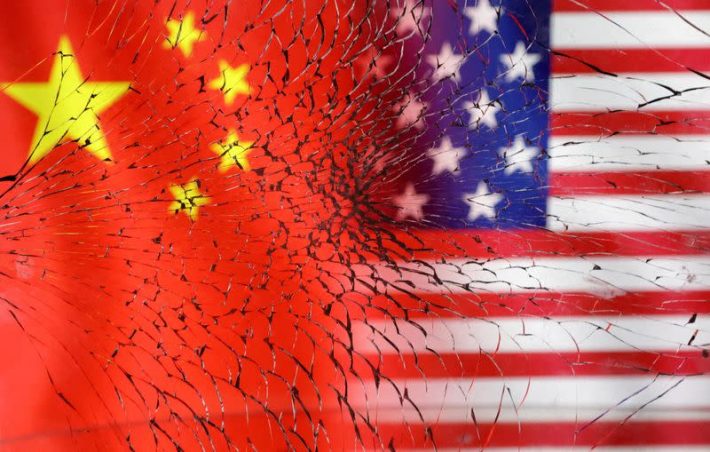
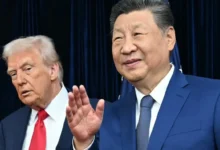
China has rejected a US call to impose sanctions on Iran. It has also been selling US Treasuries amid geopolitical tensions and alleged concerns about US policies (Reuters 2023 file image).
Chinese officials rejected a call by US leaders to back an economic war against Iran, saying on Thursday it opposes any illegal and unilateral sanctions that aren’t authorized by the UN Security Council or international law.
US Treasury Secretary Scott Bessent had called on Beijing to “get with the program” and back an economic campaign aimed at getting the Iranian regime to comply with the White House’s demands to end the war.
But Chinese Foreign Ministry said “sanctions and pressure will not help resolve the issue” and would only heighten regional tensions. It urged Washington and other parties to pursue a resolution through political and diplomatic dialogue rather than economic coercion.
US President Donald Trump, who has been under pressure at home over the impact of the war and with crucial midterm elections looming, vowed this week to isolate the Iranian economy and bring the Iranian regime to the point of collapse.
Trump’s pledge on Wednesday of unprecedented “economic warfare” on Iran comes as the president grows increasingly frustrated with the lack of movement on the military front.
In a post on his Truth Social platform, the US leader said he was announcing “the MOST CRUSHING ECONOMIC OPERATION EVER TAKEN AGAINST ANY COUNTRY! This will be Economic Warfare and Isolation on an unprecedented scale.”
Key figures at around 1100 GMT
London – FTSE 100: UP 0.2% at 10,764.14 points.
Paris – CAC 40: UP 0.1% at 8,462.58.
Frankfurt – DAX: UP 0.3% at 26,049.53.
Tokyo – Nikkei 225: DOWN 0.3% at 66,016.36 (close).
Hong Kong – Hang Seng Index: UP 1.2% at 26,009.46 (close).
Shanghai – Composite: FLAT at 3,905.20 (close).
Dollar/yen: DOWN at 158.75 yen from 159.11 yen on Thursday.
West Texas Intermediate: UP 0.3% at $87.13 per barrel
Brent North Sea Crude: UP 0.2% at $93.97 per barrel