2027: Battle for Aso Rock begins as presidential campaigns kick off
By KEMI KASUMU

“The economy is the biggest issue. That’s the one thing that cuts across different parts of the country, and it continues to affect security and development concerns,” said Afolabi Adekaiyaoja, author of The Bellwether political newsletter.
The race for Nigeria’s presidency in 2027 formally enters a new phase on Wednesday August 19, 2026 as political parties and their candidates commence campaigns ahead of the January 16 presidential election.
The contest is expected to be heavily influenced by the economy, rising cost of living, insecurity and the impact of the economic reforms introduced by President Bola Ahmed Tinubu since assuming office in 2023.
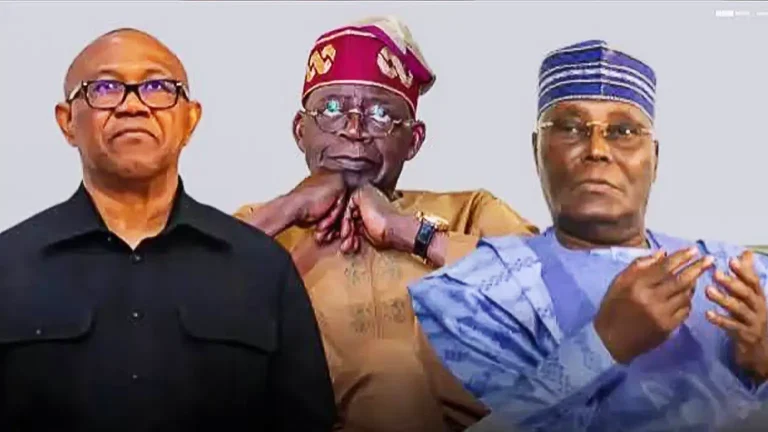
Tinubu, who is seeking a second term, is expected to face a major challenge from a fragmented opposition that includes former Vice President Atiku Abubakar, Labour Party presidential candidate Peter Obi and other contenders.
“The economy is the biggest issue. That’s the one thing that cuts across different parts of the country, and it continues to affect security and development concerns,” said Afolabi Adekaiyaoja, author of The Bellwether political newsletter.
Tinubu’s administration has implemented far-reaching economic reforms, most notably the removal of the petrol subsidy and changes to the foreign exchange regime. While economists and investors have praised the reforms as necessary for long-term economic stability, they have also contributed to severe short-term hardship for millions of Nigerians.
Inflation, which climbed to a record 34 per cent during the period under review, has since moderated, with headline inflation standing at 15.4 per cent in July.
The economic pressure has also been accompanied by a worsening poverty crisis. The World Bank estimates that more than 60 per cent of Nigerians now live below the poverty line, compared with about 40 per cent in 2019.
Nigeria is simultaneously battling several security challenges, including jihadist insurgencies, banditry, kidnapping, farmer-herder conflicts and separatist violence.
Ladd Serwat, a senior Africa analyst with conflict monitor ACLED, said violence had increased since 2024, driven particularly by the spread of armed banditry across northern and central Nigeria and renewed conflict in Borno State, the epicentre of the country’s jihadist insurgency.
But the opposition’s fragmentation could work in Tinubu’s favour.
“The opposition has been too mired in internal and legal issues to really articulate a difference” between their policies and those of the president, Adekaiyaoja said.
For many voters, however, economic hardship remains the overriding concern.
“The most important issues for me are the economy and cost of living,” said Afolayan Abdullahi, a 42-year-old civil servant who said he intended to vote for Tinubu.
2023 Rematch
The 2027 election is shaping up partly as a repeat of the 2023 presidential contest, with Tinubu again facing some of the major figures who challenged him four years ago.
Tinubu won the 2023 election with 36.6 per cent of the vote, while Atiku secured 29 per cent and Obi polled 25 per cent. Rabiu Kwankwaso, who received about six per cent, has since aligned with Obi as his running mate.
Tinubu enters the contest with significant political advantages. His All Progressives Congress controls the National Assembly and 31 of Nigeria’s 36 state governorships.
However, voter apathy remains a major concern. Only about 27 per cent of registered voters participated in the 2023 presidential election.
For some Nigerians, insecurity and the rising cost of transportation could again discourage participation.
“Nigeria is not safe — terrorists, kidnappers, bandits everywhere,” said Becky Alegbe, a 28-year-old street vendor in Abuja.
Although registered to vote in her home village in Edo State, Alegbe said she was unwilling to risk travelling for the election, citing security concerns and the dramatic increase in transportation costs.
Tinubu, Obi, Sowore, Others Sign Peace Accord
The commencement of the campaigns follows the signing of the National Peace Accord by presidential candidates and other political contestants on Tuesday.
President Tinubu, Peter Obi of the Labour Party, Omoyele Sowore of the African Action Congress, Donald Duke of the Peoples Redemption Party and other presidential candidates signed the accord at the Bola Ahmed Tinubu International Conference Centre in Abuja.
The event was attended by representatives of other presidential candidates, governorship and National Assembly candidates, the Chairman of the Independent National Electoral Commission, Joash Amupitan, Secretary to the Government of the Federation George Akume, political party chairmen and other political leaders.
The accord was organised by the National Peace Committee, chaired by former Head of State Abdulsalami Abubakar, with the Sultan of Sokoto, Muhammad Sa’ad Abubakar, and Bishop Matthew Hassan Kukah among its prominent members.
The signing represents the first phase of the peace initiative, with the second phase expected to take place after the 2027 elections.
Speaking before the signing, Obi called for a credible and peaceful election in which every vote would count.
“I don’t have any fear [going into next year’s election] except to say that, please, for the sake of the children of Nigeria, can we have an election where people’s votes will count?” Obi said.
He also urged Nigerians to reject candidates who violate the principles of the peace accord.
Asked what punishment should be imposed on politicians who breach the agreement, Obi said Nigerians should deny them their votes.
“The punishment is that Nigerians should not vote for them,” he said.
He further urged political contestants to conduct themselves responsibly throughout the campaign.
“You can’t answer ‘His Excellency’ without being an excellent person,” Obi said. “So, the process that will make you answer ‘His Excellency’ should be excellent, and the only way to do it is to conduct yourself properly.”
President Tinubu, represented at the ceremony by SGF George Akume, commended the National Peace Committee for sustaining the peace initiative since 2014.
He also credited improvements in electoral technology, particularly the Bimodal Voter Accreditation System, with strengthening the integrity of Nigeria’s elections.
According to him, the outcomes of recent off-cycle elections in Anambra, Osun and Ekiti demonstrated that different political parties could win elections under an increasingly transparent electoral process.
“Different parties won them, and local and foreign observers described them as free, credible, and transparent,” Tinubu said.
He added that greater transparency in elections would reduce post-election litigation and make politicians more accountable to voters.
With campaigns now officially underway, the 2027 presidential race is set to intensify, with the economy, insecurity, poverty, electoral credibility and the competing visions of the major candidates likely to dominate the battle for Aso Rock.